
Supervisors set hearing on ordinance to regulate use of military gear
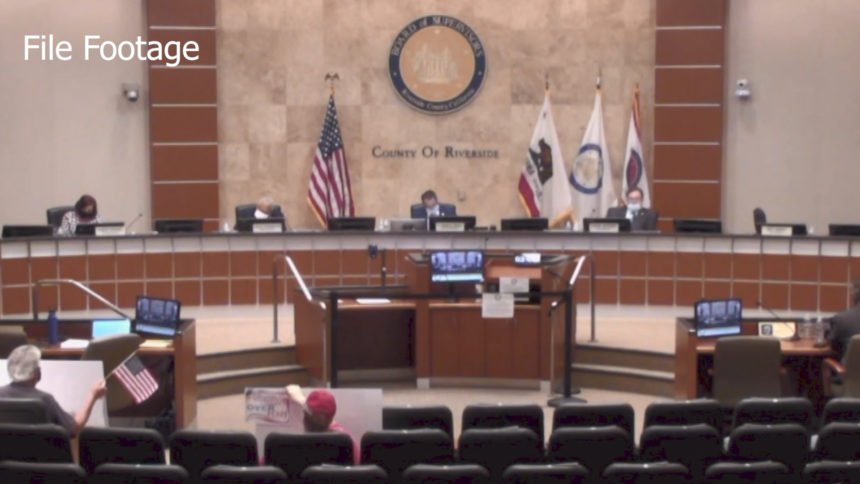

The Board of Supervisors today set a March 8 public hearing on a proposed ordinance intended to keep a tighter rein on military equipment acquisitions by the Riverside County Sheriff's Department and District Attorney's Office.
Ordinance No. 970 was drafted in response to Assembly Bill 481, signed into law by Gov. Gavin Newsom in September.
The measure requires that counties' and cities' governing bodies -- that is, boards of supervisors and city councils -- establish regulations that enable them to better monitor and control the type of military or "specialized" hardware that law enforcement agencies are procuring, as well as ensure there are safety plans on the books regarding how that equipment is deployed.
"Legally enforceable safeguards, including transparency, oversight and accountability measures, must be in place to protect the public's welfare, safety, civil rights and civil liberties before this equipment is funded, acquired or used," according to the proposed ordinance. "The lack of a public forum to discuss the acquisition of this equipment jeopardizes the relationship police have with the community, which can be undermined when law enforcement is seen as an occupying force, rather than a public safety service."
AB 481 requires that governing bodies have an ordinance approved by May 1.
According to Executive Office documents, the D.A.'s office and Sheriff's Department have already formalized standards specifying when, where and how military or specialized equipment can be deployed. The standards include additional training for users and conditions under which the gear can justifiably be fielded.
"Although most tools, equipment and resources listed as military equipment in AB 481 are found in a military environment and may be similar in nature, the application in which the equipment is used is significantly different for public safety and law enforcement," according to a public safety statement posted to the board's agenda. "With the Board of Supervisors' partnership and approval, law enforcement can operate with the most advanced technology, equipment and resources available."
According to the equipment lists furnished to the board, both the Sheriff's Department and District Attorney's Office have unmanned aerial and ground vehicles in their inventories.
The sheriff additionally maintains the following:
-- a mine-resistant ambush protected vehicle, which is armored and ostensibly intended for ``any dangerous weather condition with the ability of extreme off-road capabilities'';
-- BEAR-CAT, BOMB-CAT and TAC-CAT armored vehicles, which can be "used for breaching structures, fences or ramming objects during high-risk incidents," as well as inserting chemical agents during a standoff or neutralizing explosives;
-- explosive breaching tools, including shotgun rounds specifically designed to bust open ``fortified doors'';
-- fully automatic AR-15 or similar rifles;
-- flashbang grenades;
-- tear gas;
-- a water cannon, mounted on the BEAR-CAT;
-- a "long-range acoustic device," or LRAD;
-- less-lethal 40mm launchers, using rubber projectiles; and
-- sting-ball grenades.
The D.A.'s office separately maintains the following:
-- fully automatic AR or M-16 rifles;
-- MP5 submachine guns;
-- "command and control vehicles," such as specially equipped half-ton pickups and vans;
-- less-lethal 40mm launchers; and
-- FM303 launchers for firing less-lethal projectiles.
The agencies did not immediately respond to requests for comment concerning the value of the arsenals, and in the case of the D.A.'s office, it was unclear why fully automatic firearms and unmanned vehicles are available for deployment.
The Department of Probation was not listed as having military or specialized gear.
According to county documents, the municipalities with which the Sheriff's Department contracts for law enforcement services will need to implement their own monitoring and control measures.

