
From budget cuts to public distrust: Exploring the challenges facing local health departments

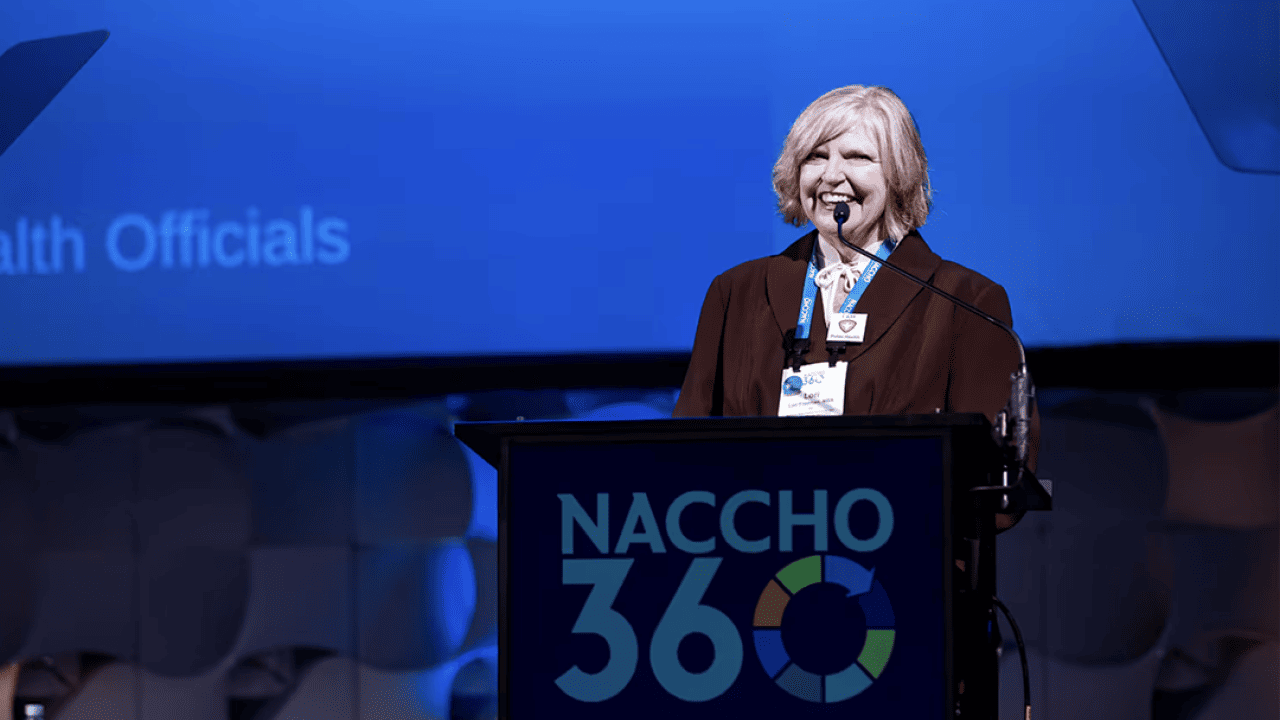
Jack Goras // 2025 NACCHO360 Conference
As CEO of the National Association of County and City Health Officials, Lori Freeman spends much of her time on the road talking with the people on the front lines of public health.
It’s been a challenging year for local health departments.
The federal government in March announced it was pulling back $11.4 billion in funding allocated across the nation for pandemic response and infrastructure, an action that has been debated in the courts. More cuts are expected amid a dramatic reorganization of the Centers for Disease Control and Prevention, which has traditionally sent about 80% of its domestic budget to states, localities, tribal organizations, and other public health partners.
Meanwhile, swaths of the American public have grown increasingly distrustful of scientific and public health institutions.
Healthbeat spoke with Freeman to get her insights on five questions about some of the current challenges facing local health departments. This interview has been edited for clarity and length.
What public health concept do you wish the public better understood?
It’s this concept that from the youngest age possible, that public health is around them, keeping them safe.
They don’t see it, but they need to know that for all of their lives, that we will be there on the ground, in their community, helping to make sure that there’s safe water to drink, safe air to breathe, safe places to play and walk, safe restaurants to eat at, safe pools to swim in.
We need to make it real for them, because we just haven’t done that.
You recently co-authored a journal article titled, “Where Do We Go From Here? The Way Forward for State and Local Public Health.” The article notes that the future of public health depends on rebuilding trust with the community. What are some ways to do that?
We talk about this a lot. There is a lot of distrust right now in our federal government, and we have to not automatically extend that distrust further down to the community, because that simply isn’t the case.
Broadly speaking, our local health departments still are very well trusted in their communities. Not as much as the No. 1 primary care physician, but close up there.
For me, this is about how we retain trust, not regain trust. We had some missteps during the pandemic, but they weren’t all of our fault at local public health. But we had to take the brunt of the punishment because we’re the closest to the ground.
We’re past that now. We want to talk about how we assure anybody coming into a local health department that they can have an honest conversation about their concerns and what they need.
If you have a young mom coming in nervous about getting a COVID vaccine, what we have to do is say: This is the information about the vaccine. And this is the information if you want to find further information about some of the side effects, or what can happen if you have certain conditions. This is what you need to know, and this is how you can research that, and how can I help you?
More open conversation about choices is where we’re headed here. It allows our health departments to stay in a neutral space, because we are completely bipartisan. We treat everybody the same.
Really focusing on honest conversation where we can. And it’s not always easy to do that. But we have to listen, and we have to understand where people aren’t meeting us in terms of understanding what public health needs are and how they can contribute.
If we don’t listen and understand that, we’re not going to address the misunderstanding that is still out there, and the mistrust.
This has been a year of significant change and disruption in public health. What are you most concerned about in the year ahead?
There’s a lot of things. One is our ability to actively respond to public health emergencies and threats. Not only are the resources changing and shrinking, but the administration that’s in place now clearly believes in a smaller federal government footprint, impact, and influence.
The partnership between federal, state, and local agencies is never more important than it is in a national public health emergency. Without an active federal component, or even a lessened federal component, the state and locals will be left to manage this more directly on their own. And I don’t know that they have the capacity to do that.
Imagine a year ago when the hurricane [Hurricane Helene] came up through multiple states, and we saw a tremendous impact in the South, in mountain areas, and across multiple jurisdictions. States and locals can’t provide that level of coordination themselves. It’s impossible.
How have the job losses at the CDC impacted local health departments?
It’s a lot of chaos right now with the workforce at the CDC. We had broad-scale layoffs. We had rescissions. I can tell you right now, nobody I talk to anywhere at the CDC or elsewhere knows where we stand.
Local health departments, they function along until they need help. Those instances are usually when there is an outbreak, a novel disease shows up in the community, [or they need] advanced testing and diagnostics. We’re seeing some instances where the CDC has been unable to respond or provide assistance.
We recognize the CDC is a huge bureaucracy with a lot of people, and maybe not all of them are needed. But we can point to real expertise that has been lost that we miss.
The CDC represents some of the most world-renowned expertise in disease. We don’t have that capacity locally. We’re not set up that way.
The level of expertise we’re losing from the CDC is alarming. This CDC that we are seeing right now is a fully burned-down version of what we were experiencing a year ago.
Your recent journal article focused on ways public health departments can move forward in the current climate. What are some of the key suggestions?
Look at your core mission. Look at who you are serving, and make sure that you are really targeting what you need to do in the community.
If we continue down this road of federal back-out of supporting public health, health departments really have to look at what are the core things that we have to worry about to keep our community safe. Drinking water, environment, clean air, safe places to eat, keeping communities free of disease — and really honing in on those and letting the rest of the things fall away for now or get diminished. It’s going to be painful.
Some of those core services in local public health are supported by regulatory funding. They’re able to get funding for licensing and inspections. We can still do things at a basic level.
That’s one way to look forward. It’s not an ideal way.
We have to keep returning to our own visionary model of public health. We are the public health strategist for the community, convening and organizing our partners in a way that blends funding support resources across the community.
Some of our communities have already moved here. You have some states and locals who have disengaged and disentangled themselves from federal funding to the extent that they feel far less pain. A lot of these are conservative, red states. They have a story to tell and one that is important for us to learn from. How did they do it, and are they successful at it?
Our partners have to be different and expanded. We have never attempted, as far as I can tell, to try to tie ourselves more closely to the spectrum of health.
Public health is just the pre-health care part of it: Everything that we do [in public health] that you don’t always see that is keeping you from going to the doctor and that is keeping you from having to seek health care, and that is keeping our communities healthy as a whole.
This story was produced by Healthbeat and reviewed and distributed by Stacker.

