
‘There’s a hunger to express yourself’: A dispatch from China’s most fashionable city

By Stephy Chung, CNN
Shanghai, China (CNN) — One of China’s most exciting art curators, X Zhu-Nowell, is giving me a very Shanghai morning. We share a breakfast of traditional staples –– scallion pancakes, salty bean curd and soup dumplings –– in an Art Deco museum building as she recalls the work of the Chinese American writer Eileen Chang, who was born in 1920s Shanghai.
“They’re the first thing that comes to mind,” Zhu-Nowell said of Chang’s vivid descriptions of the cheongsam, or qipao, which often serve as sociological lenses through which we understand her characters –– from how the textiles match, to the fit and even how humidity comes into play.
Historically, Shanghai (which birthed the modern qipao) has always been very open to different styles, they added. “People have always been inspired by so much of the landscape and the cityscape, and also the international influence that comes into the city.”
I’m in the “Paris of the East” for the tail-end of Shanghai Fashion Week to see what some of China’s most exciting designers are working on today. But I also want to interrogate Shanghai’s style identity, beyond the runways, through the people who live here.
“It’s probably China’s most dressed-up city,” said the curator. “The kids are really adventurous with their style, and it’s always personal. Guangzhou people like to wear flip flops. Beijing is very chill.”
Zhu-Nowell is executive director and chief curator of Shanghai’s Rockbund Art Museum, which occupies a 1930s building renovated by British architect David Chipperfield in 2010. The five-story brick structure anchors the historic Rockbund neighborhood, a charming area near the iconic Bund riverfront with an impressively high concentration of Art Deco buildings. Blue-chip art galleries, indie boutiques and lifestyle brands –– like Beast, a Chinese perfume maker whose store heaves with floral displays and dispenses perfumes from playful wood-carved animals, and Songmont, which creates architectural, Chinese heritage-inspired bags.
A collision of art and architecture, the area has also become a photogenic backdrop for fashion lovers. By around 9 a.m., I’d seen over a dozen photo shoots taking place – a bride-to-be in a strapless wedding dress and knee-high boots; a 20-something aspiring model in a white winter puffer posing for a Taobao store ad; a woman embracing Old Shanghai-style glamour with finger-wave curls and a green floral qipao; and a gaggle of well-turned-out grannies striking poses.
“The children have grown up, and now we’re enjoying our lives into old age, but our hearts are young,” said one of them, 69-year-old Didi. She humbly described her style as “sui yi,” or very “whatever,” though it seemed anything but. “Shanghai is more forward when it comes to fashion, it’s true. I like to look cleaner… more put together.”
Waiting to get into Mark Gong’s Shanghai Fashion Week show, I stood beside Abigail Man, a 30-year-old influencer styled in a sheer, lacy, high-necked top and leopard-print jeans (both by the designer’s eponymous brand). I’d seen her earlier that day at Samuel Guì Yang’s show, where she stood out from the crowd thanks to both her striking bob, reminiscent of Japanese anime character Paprika, and her unexpected pairing of a loose-fitting poppy-motif tunic with the label’s Adidas collaboration track pants.
Man told me she moved to Shanghai after years in New York and Dalian, her hometown in northeastern China. She liked it here because the people are “willing to look bolder, compared to other places.”
Shanghai, and China as a whole, has become turbo-charged and hyper modern with high tech infrastructure and AI. The city itself felt largely quiet with the hum of so many electric vehicles. No one uses cash, everything is on an app, everything can be bought at lighting speed.
That speed contributes to a palpable sense of possibility. Landon Du, the project director of Shanghai Fashion Week’s organizing committee, talked about how compared to style capitals like Milan and Paris, and their heritage brands, in China: “Fashion is young. Brands are young. Designers are young. The audience is young.”
Samuel Guì Yang, who showed off-schedule at another 1930s venue, epitomizes what many young people in today’s China desire: reinterpreting and bringing traditional Chinese aesthetics into design. For that, the work by him and co-founder Erit Litzén, who met at London’s Central Saint Martins, is often categorized as “new Chinese style.” They don’t necessarily identify with the label that is often thrust upon them –– as they’ve long merged Eastern and Western visual codes –– but the pair recognize they’re part of a wider movement built around China’s growing cultural confidence.
“There’s an energy, a hunger, and a will to express yourself here,” said Litzén. “Not just in Shanghai, but in China. There’s a huge surge of people who want to explore fashion and culture in a broader sense. It’s really fertile ground for young businesses.”
Based in both London and Shanghai, Samuel Guì Yang has opened its first physical store last weekend. The label chose a spot on Julu Road, a popular tree-lined street in Shanghai’s former French quarter packed with little boutiques and independent Chinese designers.
Outside one of its cafes I find 30-year-old Ma Xue Li, who is visiting from nearby Zhejiang province to work at the Rolex Shanghai Masters tennis tournament. She’s tucking into a good-looking slice of cheesecake and sitting next to her friend’s equally good-looking dog (in a yellow pastel vest embroidered with flowers and a ruffled white trim).
“It’s daring, its fearless,” she observes of how people in Shanghai dress. “More importantly, it’s a way of life where you don’t have to fit into certain social norms or expectations.”
Osschaert, one of the event’s last shows, took me by surprise. Designer duo Kong Yue and Xie Yonghao eschewed a traditional runway for a poignant, at times unsettling theater presentation about memory and loss, with the actors mostly in white garment prototypes, before eventually appearing together in their finalized, ethereal forms.
It appeared to resonate with the crowd. Richard Chan, who heads product development and design at Disney’s fashion department in Shanghai, said he felt the show represented how Chinese brands are increasingly connecting with people through storytelling, not just clothes.
More broadly, Chan said, “there’s a big shift in the way people have chosen to exercise their creativity in society.”
“It can be across food, clothing, the way people enjoy tourism,” he said, pointing to barbecue street snacks that can now be had in bright, glamorous eateries, or the new bars that serve cocktails based on ingredients used in traditional Chinese medicine.
“Everything becomes more authentically Chinese, but through the lens of the modern world.”
Scroll down for some of shows from Shanghai Fashion Week.
Shanghai Fashion Week featured over 80 runways shows and presentations. Du, the project director of its organizing committee, said that over the past decade, Chinese labels have developed “stronger brand DNA.”
“I think in the past, when Chinese designers graduated from Western design schools, they followed trends. But now when they do their own collections, they have more self-expression… which makes them more distinctive,” he said, speaking after the Shuting Qiu runway. “In recent years, they will incorporate more Chinese identity and elements in their designs, in a modern and contemporary way.”
Designer Mark Gong, worn by the likes of Rihanna, Charli XCX and Jennie, put on a romantic show. The skirts were super flirty and bounced a lot and everyone in the audience looked hot.
Samuel Guì Yang’s latest collection is named after, and inspired by, the 1990s Hong Kong film “Green Snake,” starring Maggie Cheung. They were both figurative and literal references to the animal, with snakeskin patterns and fabrics that moved as if they were slithering. A painting of tides by Southern Song dynasty painter Ma Yuan influenced the collection’s notions of water and fluidity. The designers spoke about “feeding themselves” with inspiration from Shanghai by going to old bookshops, the parks and ghost markets.
Models literally ran down the catwalk at times during Adidas’ high-octane show with multiple acts. Singer Veegee wore a voluminous skirt layered with cuts of tracksuits and flannel during one performance. The event, held at the ROJO Art Space, included exhibition-like experiences and a tennis court. It’s all in the details. Even the mini bamboo baskets serving up little delicacies before the show bore the brand’s signature three stripes.
At Osschaert, the audience was transported to a forest with leaves scattered on the ground and turf, entering a dream-like set that centered around a young, aspiring designer’s workshop. One by one, her cohorts are led away by a ghostly figure, who says, “When time is up, I appear.”
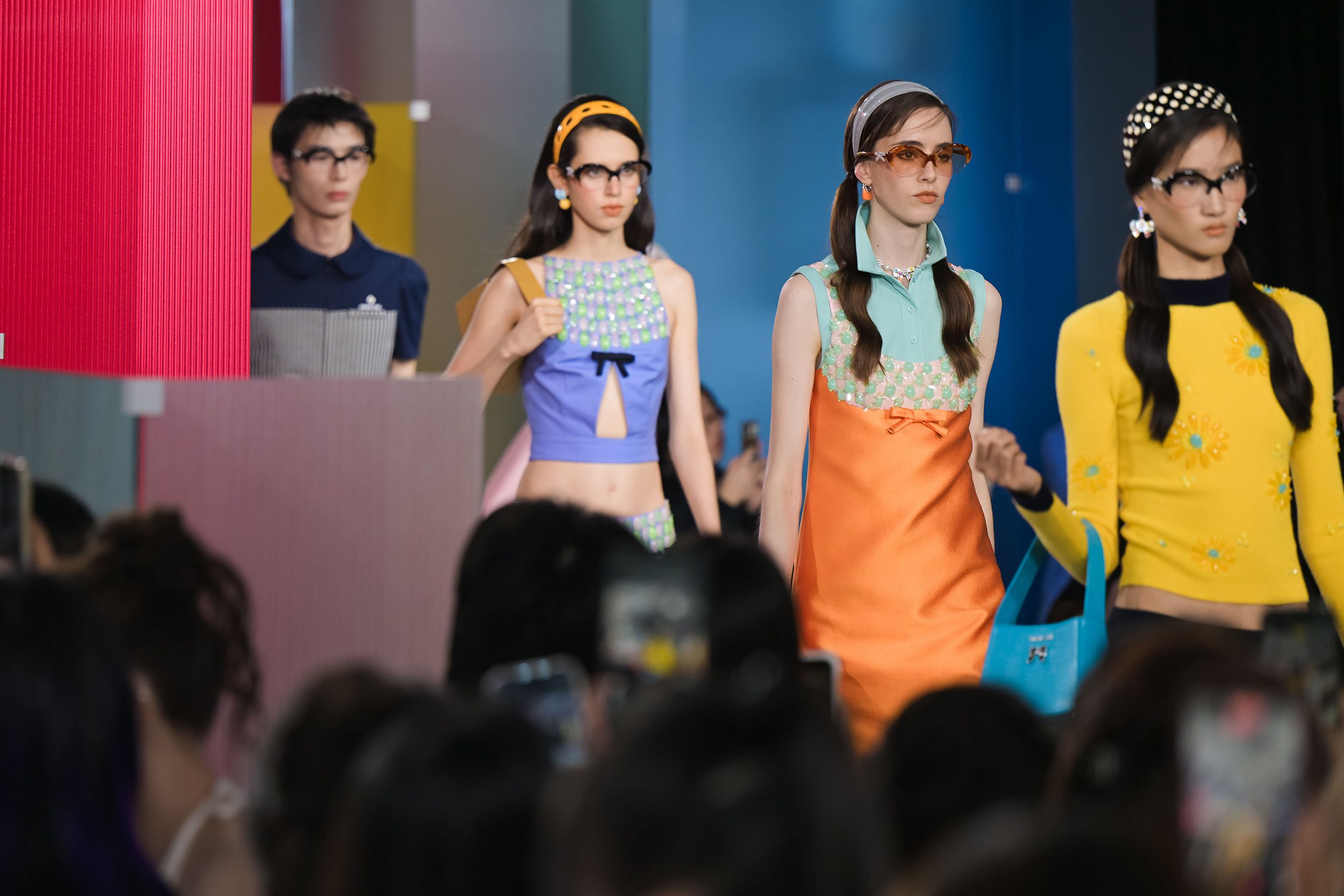
A parade of nerdy chic models strutted down the Shushu/Tong runway. I was obsessed with the girly girl vibe struck by the brand’s new collection. It’s giving quasi-nerd who loves a little retro styling and a cute bubble skirt.
Backstage at Youtopia, I spoke with Tasha Liu, a leader on the Shanghai fashion scene for co-founding Labelhood, an incubator for Chinese brands, that also helped to stage shows like Mark Gong and Shushu/Tong during the event. Youtopia platformed the work of emerging Chinese designers, many recent graduates. “More and more designers will focus on their own culture,” Liu said. “They will be true to themselves.” At the finale, models walked down with boxes for audiences to cast votes for their favorite look.
The-CNN-Wire
™ & © 2026 Cable News Network, Inc., a Warner Bros. Discovery Company. All rights reserved.
