
After a crash, can blood reach you in time?

By Ryan Kelley for ImageTrend

Alicia Raebel was grocery shopping with her three sons when a crash-alert service called. Her husband, John Mazanec, had been in a motorcycle wreck. He was not answering his phone.
After a truck turned across his path in Pueblo, Colorado, on Sept. 4, 2025, paramedics found him bleeding heavily. Another crew brought blood from the ambulance company’s base, and his transfusion began on the way to the hospital. The local program had launched just eight days earlier, according to an August 2026 account published by UCHealth.
“Had they not started me on the blood, I don’t think I would be here,” Mazanec told UCHealth.
Mazanec’s case is one example of a treatment occurring across the country. Drawing on a representative sample of U.S. EMS incidents, ImageTrend’s 2026 EMS Insights Report documented 1,695 crash patients receiving blood before hospital arrival in 2025. Those cases offer a broader picture of how blood reaches patients.
But receiving blood before reaching a hospital is far from universally available. America’s Blood Centers, an association representing independent blood centers, estimates that only 1% to 2% of EMS agencies nationwide carry blood.
Starting Jan. 1, 2027, TRICARE, the health program for service members, retirees and their families, will test whether paying ambulance providers separately for blood products and transfusion services improves access and patient outcomes for eligible beneficiaries.
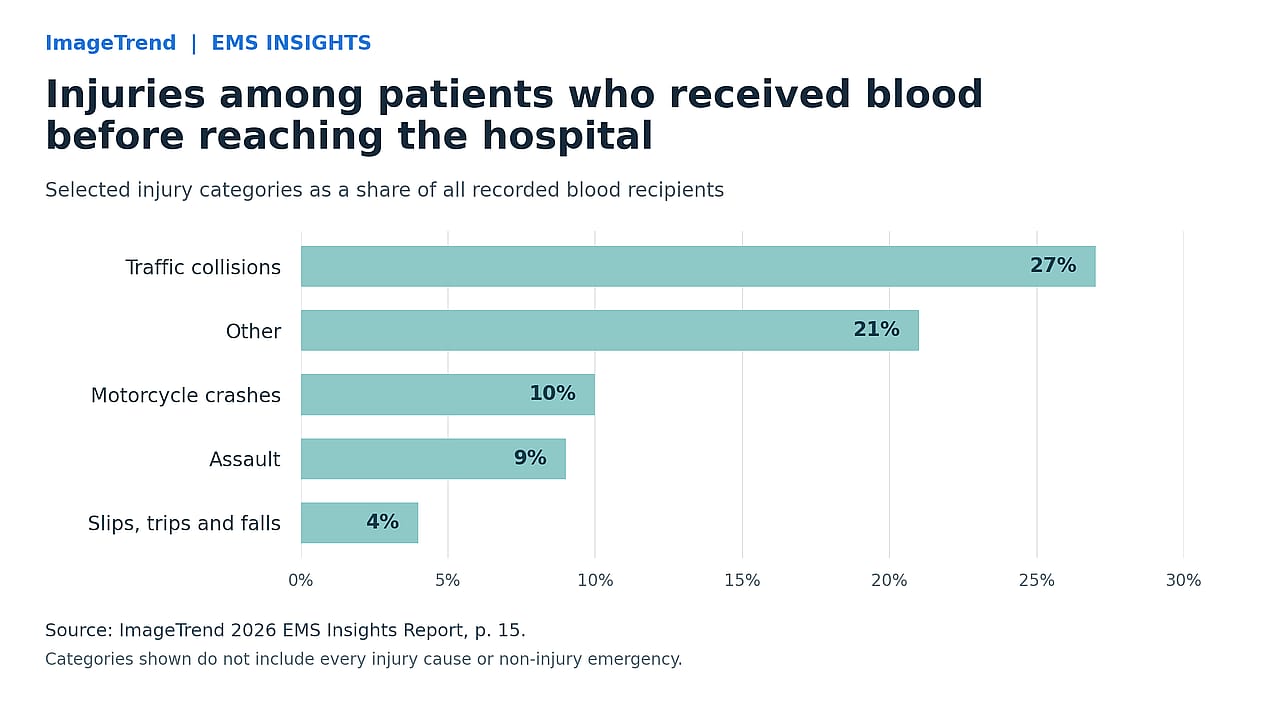
Across the report’s blood-treatment records, 80% of responses involved trauma, 44% of recipients were ages 20 to 49 and 68% were recorded as male. Nearly 2 in 5 recipients were injured in traffic or motorcycle crashes.
For a severely injured patient, waiting until hospital arrival can mean continuing to lose blood during the ride. Uncontrolled bleeding from traumatic injuries is a leading cause of preventable death, according to the American College of Surgeons, and a significant loss can become fatal within minutes.
Giving blood before hospital arrival, called prehospital blood transfusion, allows responders to begin replacing what a patient has lost. A 2025 clinical practice guideline from the Prehospital Blood Transfusion Coalition supports early transfusion for patients in hemorrhagic shock, when blood loss leaves the body unable to maintain adequate circulation.
Blood is not needed for every crash injury. Clinicians select patients using medical protocols, and a transfusion cannot replace bleeding control or surgery to repair internal injuries.
How blood reaches patients depends on the local response
According to the EMS Insights Report, in 2025, air units performed 87% of the report’s documented blood administrations, while ground units performed 10%. These figures include emergencies beyond crashes.
Across the blood-treatment records, 42% of responses occurred in rural counties. Ground-unit transfusions were more concentrated in urban counties, where 77% took place.
In the report’s motor-vehicle-crash analysis, blood was recorded in 0.67% of rural EMS activations, compared with 0.08% in metro areas.
For someone injured on a road outside town, or on a city street, those findings raise a practical question: Which crew could bring blood to the scene or administer it during the trip to a hospital?
An emergency blood program does not require every ambulance to carry blood. The federal Office of EMS describes regional programs in which 911 centers can dispatch blood resources to an emergency. One crew can bring blood to another already treating a patient, as happened in Mazanec’s case.
That means the estimate that only 1% to 2% of EMS agencies carry blood tells just part of the story. A crew that doesn’t stock blood may still be able to get it from another responding unit. Counting agencies alone cannot show which communities have access or how quickly blood can reach a patient.
The cost of keeping blood ready for the next emergency
A donated unit of blood needs a system to collect it, prepare it and make it available for treatment. America’s Blood Centers says blood product costs can run $500 to $925 or more per unit. The association argues that bundled ambulance payments do not adequately cover those costs.
Ambulance programs also need temperature-monitored coolers, equipment to warm blood for transfusion and trained clinicians. Arrangements with blood suppliers and hospitals must cover replenishment and unused products. Keeping that service ready creates expenses even between emergencies.
A payment pilot will test a way to expand access
The Centers for Medicare & Medicaid Services moved transfusions into a higher ground-ambulance payment category in 2025, but blood remains bundled into the transport payment.
Under a federal notice published in July, TRICARE providers will be able to bill separately for medically necessary blood products and transfusion services during qualifying transports for eligible beneficiaries. The five-year pilot runs through Dec. 31, 2031, and will assess access, outcomes and costs.
Communities are exploring new ways to deliver blood
In Florida, a new demonstration explores delivery by air without an ambulance helicopter. On Oct. 1, 2026, Hillsborough County Fire Rescue demonstrated a drone blood-delivery program intended to bring a temperature-controlled unit of whole blood directly to an emergency scene at a paramedic’s request.
The initial service is planned for two areas of unincorporated Hillsborough County covering 70 square miles. The department projects three and a half minutes or less from request to blood administration. That is a performance target, rather than a reported result from patient care.
The county’s October announcement said live operations were expected in the coming weeks, with the first year serving as a proof of concept.
By tackling delivery times and financing, the drone program and reimbursement pilot address different parts of the same life-or-death problem: getting blood to a patient while it can still save them.
Residents can help before the next emergency
A useful question for your local EMS agency is whether blood can reach a severely bleeding patient before hospital arrival. Ask how it gets there and how the service is supported. That opens a more useful conversation than asking only whether one ambulance carries blood.
Blood donation supports the supply that hospitals and ambulance programs depend on. Contact a local blood center about eligibility and appointments. The federal Office of EMS identifies blood-bank partnerships and community blood drives as ways to support programs.
Residents can also learn bleeding control through the American College of Surgeons’ Stop the Bleed training, which teaches direct pressure, wound packing and appropriate tourniquet use. If you encounter a crash, protect your own safety, call 911 and follow dispatcher instructions.
Mazanec underwent surgeries and rehabilitation. By summer 2026, he was fishing again with his wife and sons, UCHealth reported.
The transfusion was an early step in a long recovery. Making that step possible for another family requires blood donors, trained responders and a way to sustain the service before the next emergency begins.
About the research
ImageTrend used Collaborate data, an opt-in nationally representative dataset of de-identified EMS records from more than 3,100 organizations. The 2026 EMS Insights Report identifies blood treatment through procedure and medication records, however, documentation practices may vary by agency.
This story was produced by ImageTrend and reviewed and distributed by Stacker.
Alicia Raebel was grocery shopping with her three sons when a crash-alert service called. Her husband, John Mazanec, had been in a motorcycle wreck. He was not answering his phone.
After a truck turned across his path in Pueblo, Colorado, on Sept. 4, 2025, paramedics found him bleeding heavily. Another crew brought blood from the ambulance company’s base, and his transfusion began on the way to the hospital. The local program had launched just eight days earlier, according to an August 2026 account published by UCHealth.
“Had they not started me on the blood, I don’t think I would be here,” Mazanec told UCHealth.
Mazanec’s case is one example of a treatment occurring across the country. Drawing on a representative sample of U.S. EMS incidents, ImageTrend’s 2026 EMS Insights Report documented 1,695 crash patients receiving blood before hospital arrival in 2025. Those cases offer a broader picture of how blood reaches patients.
But receiving blood before reaching a hospital is far from universally available. America’s Blood Centers, an association representing independent blood centers, estimates that only 1% to 2% of EMS agencies nationwide carry blood.
Starting Jan. 1, 2027, TRICARE, the health program for service members, retirees and their families, will test whether paying ambulance providers separately for blood products and transfusion services improves access and patient outcomes for eligible beneficiaries.
Who receives blood before reaching the hospital
Across the report’s blood-treatment records, 80% of responses involved trauma, 44% of recipients were ages 20 to 49 and 68% were recorded as male. Nearly 2 in 5 recipients were injured in traffic or motorcycle crashes.
For a severely injured patient, waiting until hospital arrival can mean continuing to lose blood during the ride. Uncontrolled bleeding from traumatic injuries is a leading cause of preventable death, according to the American College of Surgeons, and a significant loss can become fatal within minutes.
Giving blood before hospital arrival, called prehospital blood transfusion, allows responders to begin replacing what a patient has lost. A 2025 clinical practice guideline from the Prehospital Blood Transfusion Coalition supports early transfusion for patients in hemorrhagic shock, when blood loss leaves the body unable to maintain adequate circulation.
Blood is not needed for every crash injury. Clinicians select patients using medical protocols, and a transfusion cannot replace bleeding control or surgery to repair internal injuries.
How blood reaches patients depends on the local response
According to the EMS Insights Report, in 2025, air units performed 87% of the report’s documented blood administrations, while ground units performed 10%. These figures include emergencies beyond crashes.
Across the blood-treatment records, 42% of responses occurred in rural counties. Ground-unit transfusions were more concentrated in urban counties, where 77% took place.
In the report’s motor-vehicle-crash analysis, blood was recorded in 0.67% of rural EMS activations, compared with 0.08% in metro areas.
For someone injured on a road outside town, or on a city street, those findings raise a practical question: Which crew could bring blood to the scene or administer it during the trip to a hospital?
An emergency blood program does not require every ambulance to carry blood. The federal Office of EMS describes regional programs in which 911 centers can dispatch blood resources to an emergency. One crew can bring blood to another already treating a patient, as happened in Mazanec’s case.
That means the estimate that only 1% to 2% of EMS agencies carry blood tells just part of the story. A crew that doesn’t stock blood may still be able to get it from another responding unit. Counting agencies alone cannot show which communities have access or how quickly blood can reach a patient.
The cost of keeping blood ready for the next emergency
A donated unit of blood needs a system to collect it, prepare it and make it available for treatment. America’s Blood Centers says blood product costs can run $500 to $925 or more per unit. The association argues that bundled ambulance payments do not adequately cover those costs.
Ambulance programs also need temperature-monitored coolers, equipment to warm blood for transfusion and trained clinicians. Arrangements with blood suppliers and hospitals must cover replenishment and unused products. Keeping that service ready creates expenses even between emergencies.
A payment pilot will test a way to expand access
The Centers for Medicare & Medicaid Services moved transfusions into a higher ground-ambulance payment category in 2025, but blood remains bundled into the transport payment.
Under a federal notice published in July, TRICARE providers will be able to bill separately for medically necessary blood products and transfusion services during qualifying transports for eligible beneficiaries. The five-year pilot runs through Dec. 31, 2031, and will assess access, outcomes and costs.
Communities are exploring new ways to deliver blood
In Florida, a new demonstration explores delivery by air without an ambulance helicopter. On Oct. 1, 2026, Hillsborough County Fire Rescue demonstrated a drone blood-delivery program intended to bring a temperature-controlled unit of whole blood directly to an emergency scene at a paramedic’s request.
The initial service is planned for two areas of unincorporated Hillsborough County covering 70 square miles. The department projects three and a half minutes or less from request to blood administration. That is a performance target, rather than a reported result from patient care.
The county’s October announcement said live operations were expected in the coming weeks, with the first year serving as a proof of concept.
By tackling delivery times and financing, the drone program and reimbursement pilot address different parts of the same life-or-death problem: getting blood to a patient while it can still save them.
Residents can help before the next emergency
A useful question for your local EMS agency is whether blood can reach a severely bleeding patient before hospital arrival. Ask how it gets there and how the service is supported. That opens a more useful conversation than asking only whether one ambulance carries blood.
Blood donation supports the supply that hospitals and ambulance programs depend on. Contact a local blood center about eligibility and appointments. The federal Office of EMS identifies blood-bank partnerships and community blood drives as ways to support programs.
Residents can also learn bleeding control through the American College of Surgeons’ Stop the Bleed training, which teaches direct pressure, wound packing and appropriate tourniquet use. If you encounter a crash, protect your own safety, call 911 and follow dispatcher instructions.
Mazanec underwent surgeries and rehabilitation. By summer 2026, he was fishing again with his wife and sons, UCHealth reported.
The transfusion was an early step in a long recovery. Making that step possible for another family requires blood donors, trained responders and a way to sustain the service before the next emergency begins.
About the research
ImageTrend used Collaborate data, an opt-in nationally representative dataset of de-identified EMS records from more than 3,100 organizations. The 2026 EMS Insights Report identifies blood treatment through procedure and medication records, however, documentation practices may vary by agency.
This story was produced by ImageTrend and reviewed and distributed by Stacker.
