
How much is the NFL worth? Inside America's most valuable sports league


The NFL is America’s biggest professional football league, but it is also a multibillion-dollar economic ecosystem spanning media rights, franchise valuations, player salaries, stadium investment, advertising, merchandise, sports betting and prediction markets.
With 32 teams, more than $23 billion in annual revenue and an average franchise value of $7.1 billion in 2026, the league has become a major commercial force with links to a wide range of industries and financial markets.
As the 2026 NFL season approaches, its economic footprint is expanding further. With a record $301.2 million salary cap, $110 billion in domestic media rights and the growing role of prediction markets, the NFL offers a useful lens into how sport, business and financial markets increasingly intersect.
TL;DR
- A more than $23 billion NFL economy: The league generated more than $23 billion in revenue in 2025-26.
- Record franchise values: The average team value reached $7.1 billion in 2026, up 31% year on year.
- NFL salary cap ($301.2 million): The 2026 cap is the highest in NFL history.
- $110 billion media rights: Broadcast deals remain the league’s biggest financial engine.
- NFL betting and fantasy boom: NFL popularity fuels major sports betting and fantasy markets.
- Prediction markets grow: NFL contracts are becoming a major part of the expanding prediction-market sector.
- 2026 season kickoff: Seattle faces New England on Sept. 9, 2026.
What is the NFL?
The NFL (National Football League) is the top professional American football league in the United States.
It has 32 teams, including the Kansas City Chiefs, Philadelphia Eagles, Dallas Cowboys, and San Francisco 49ers. The teams are divided into two conferences, the AFC and NFC, with four divisions in each.
The basic idea of American football is to move an oval-shaped ball down the field and score. A touchdown is worth 6 points, and teams can also score with field goals and other plays. Each team gets a series of attempts called downs to advance the ball.
The NFL season generally runs from September through January, followed by the playoffs. The champions of the AFC and NFC then meet in the Super Bowl, the NFL’s championship game and one of the biggest annual sporting events in the U.S.
How big is the NFL?
The NFL generated more than $23 billion in total revenue in the fiscal year that ended last March, a figure that surpasses the annual GDP of over 80 countries. Each of its 32 franchises received a national revenue share of more than $450 million for the 2025 season alone, representing a 5% year-on-year increase, according to Sportico.
That shared revenue is the NFL’s structural advantage: unlike most sports leagues, every team benefits from the same national media and licensing deals, creating a financial floor that no other major sports league replicates.
Key NFL revenue benchmarks:
- Total NFL revenue: Over $23 billion (fiscal year 2025-26)
- National revenue per team: Over $450 million
- Average NFL franchise value (2026): $7.1 billion (up 31% year-on-year per Sportico)
- Most valuable franchise: Dallas Cowboys at $15.5 billion (Sportico 2026)
- No. 2: Los Angeles Rams at $12.7 billion
- No. 3: New York Giants at $12 billion
The Cowboys’ $15.5 billion valuation makes them not just the most valuable NFL franchise, but the most valuable sports franchise in the world.
The NFL salary cap
The 2026 NFL salary cap is set at $301.2 million per team, the highest in league history. This figure directly controls how 32 organizations allocate hundreds of millions of dollars across rosters of 53 players, making it one of the most-watched financial metrics in American sports.
Key NFL salary cap figures:
- Total player compensation across all 32 teams: approximately $12.1 billion
- Player benefits and performance pay: $77.6 million per team
- Minimum NFL player salary (2026): approximately $870,000 per year
- Top cap hits: Matthew Stafford (LAR) at $48.3 million, Justin Herbert (LAC) at $46.3 million and Chris Jones (KC) at $44.9 million
Why NFL cap space matters:
Salary cap management has become a proxy discipline for financial strategy. NFL cap space can absorb talent — teams over the cap face structural constraints identical to a leveraged company. NFL general managers are, in effect, running a $300 million annual profit and loss statement. The NFL’s franchise tag, a mechanism that allows teams to retain a player at a set salary, is one of the most debated financial instruments in the league, carrying its own search volume (there were 12,100 Google searches for “nfl salary cap” in August) precisely because fans follow it like a market.
The $110 billion media rights machine
No single factor explains the NFL’s financial dominance more than its broadcast agreements. The NFL holds $110 billion in domestic broadcast rights across Amazon, CBS, ESPN/ABC, Fox, and NBC, a package running through 2032 with an opt-out clause active from 2029.
- NBCUniversal pays approximately $2 billion per year for its NFL package.
- Amazon Prime Video holds exclusive rights to Thursday Night Football.
- The NFL is actively exploring renegotiation of terms ahead of the 2026 season, with networks already signaling appetite for higher valuations.
These deals dwarf any other sports rights package in history. For comparison, the entire Premier League’s global broadcast deal is valued at roughly $12 billion over three years. The NFL earns more than that annually.
What this means for markets
When broadcast rights values rise, they flow directly into franchise valuations. NFL team values have increased an average of 31% in a single year, according to 2026 Sportico data, partly driven by the expectation of renegotiated media contracts at even higher levels. Investors who track media sector stocks, Disney (ESPN), Fox, and Comcast (NBC), are indirectly tracking NFL economics.
The stadium investment boom
The NFL is currently in the middle of its largest wave of stadium construction in decades. Several franchises are committing billions to new facilities, each with significant local economic implications:
- Buffalo Bills – New Highmark Stadium: $2.1 billion, opening 2026 season in Orchard Park
- Kansas City Chiefs – New domed stadium: estimated $3 billion, with up to $1.8 billion (60%) in public funding
- Las Vegas Raiders – Allegiant Stadium cost $1.97 billion at opening, $750 million from public funds
New stadiums generate direct construction employment, long-term hospitality and retail revenue, and property value uplift for surrounding neighborhoods. The economic debate over public funding, often representing hundreds of millions in taxpayer dollars, has intensified as stadium costs escalate.
The draft as an economic event
The NFL Draft is no longer just a talent selection process. It has become a major economic activation in its own right.
The 2026 NFL Draft in Pittsburgh drew a record 805,000 attendees and generated:
- $177 million in direct regional economic impact
- $1.5 billion in total economic value (per analytics firm Trajektory)
- $126 million in direct visitor spending
Cities now compete aggressively to host the draft, treating it as equivalent to hosting a major international sporting event. For Pittsburgh, the 2026 draft outperformed expectations by a measurable margin, a case study in how NFL events translate directly into local GDP.
NFL betting: Parallel economy
The legalization of sports betting across most U.S. states has created a parallel financial ecosystem tightly coupled to NFL outcomes. The global sports betting market is valued at $124.88 billion in 2026, projected to reach $325.71 billion by 2035.
In the U.S. specifically:
- U.S. sportsbooks processed more than $40.47 billion in handle in Q1 2026 alone.
- U.S. sports betting gross gaming revenue: $3.82 billion in Q1 2026.
- Sports betting is legally available in over 38 states.
NFL betting is the dominant driver of American sports betting volume. NFL betting lines, spreads, and prop markets generate the highest handle of any sport throughout the September-January regular season window. The integration of betting into official NFL broadcasts, through data partnerships and in-broadcast odds display, has formalized what was previously a shadow market.
Fantasy football: A $43.7 billion market
An estimated over 40 million Americans participate in fantasy football, making it one of the largest participation-based financial markets in sports. The global fantasy sports market is projected at $43.74 billion in 2026, growing to $137.81 billion by 2035.
Fantasy participation drives:
- Direct platform spending (entry fees, premium subscriptions)
- Increased viewership across all games (not just team-loyalty matchups)
- Higher NFL merchandise and NFL ticket demand correlated with fantasy roster holdings
For the NFL, fantasy football functions as a subscriber retention mechanism. Fans who play fantasy are structurally more engaged across the entire season, not just with their local team.
NFL merchandise and the retail market
NFL-licensed merchandise represents a significant retail vertical. The launch of new team uniforms, new stadium branding, and major player trades all generate immediate merchandise revenue spikes. When a high-profile player changes teams, triggering jersey replacement cycles across millions of fans, the financial impact flows directly to the NFL’s licensing revenue.
NFL merchandise sales by team are tracked as a leading indicator of fan engagement and brand strength, with search volume on SemRush for “nfl merchandise” running at 6,600 searches in August and “nfl jersey sales” at 2,400, both with measurable commercial advertiser spend behind them.
Super Bowl economics
The Super Bowl is the single-largest annual economic event in American sports. Super Bowl LX (2026), played at Levi’s Stadium in the San Francisco Bay Area, generated an estimated $720 million in total economic activity for the region, tripling the impact of a typical major sporting event in the same market.
Super Bowl economic impacts typically include:
- Hotel, hospitality, and food & beverage revenue
- Transportation and logistics spending
- Broadcasting and advertising revenue (over $7 million per 30-second ad slot)
- Long-tail tourism from media attention
The city selection process for Super Bowl hosting rights has itself become a competitive economic negotiation, with municipalities committing infrastructure investment to secure the event.
The Super Bowl Indicator: A famous market signal
One of Wall Street’s most enduring curiosities is the Super Bowl Indicator, a spurious correlation first noted in 1978 that suggests the S&P 500’s annual direction can be predicted by which conference wins the Super Bowl. The theory: An NFC winner signals a bull market while an AFC winner signals a bear market.
Historically, the indicator has held roughly 75%-80% of the time, far above chance, though statisticians are quick to note the correlation is coincidental rather than causal.
Super Bowl LX (February 2026): The Philadelphia Eagles (NFC) won, the indicator pointed bullish for 2026. Its value for traders is not predictive; it is a reminder that financial markets and major sporting events share an audience, and that sentiment, attention, and consumer confidence move in cycles that the NFL season helps shape.
Sector futures: Where NFL seasonality shows up
For traders active in futures, the NFL season creates identifiable seasonal patterns in several underlying markets:
- Consumer discretionary: NFL season drives Q3-Q4 restaurant, retail, and electronics spending. Big-screen TV sales correlate with NFL season openers and playoff runs.
- Media company earnings: NFL broadcast inventory is the most expensive advertising real estate in the U.S. A 30-second Super Bowl slot trades above $7 million. The knock-on effect on Fox, Disney, Comcast, and Amazon EBITDA margins flows into Q4 and Q1 earnings seasons.
- Advertising pricing: NFL CPM rates set a ceiling for all other U.S. broadcast inventory, influencing media sector valuations across the board.
NFL prediction markets
Prediction markets are one of the fastest-growing financial instruments in the U.S., and the NFL is their single biggest underlying asset.
Unlike traditional sportsbooks where you bet against the house, prediction markets are structured more like futures exchanges, where participants buy and sell contracts on the probability of outcomes, with prices moving in real time as new information enters the market. They are federally regulated by the Commodity Futures Trading Commission (CFTC), not state gaming commissions, placing them firmly in the financial instrument category.
How NFL prediction markets work
Each outcome is a contract that trades between $0 and $1. If you buy a contract on the Los Angeles Rams winning Super Bowl LXI at $0.15, you collect $1 if the Rams win and $0 if they don’t. The price at any point reflects the market’s collective implied probability.
The regulatory moment
Prediction markets occupy a genuinely novel regulatory space in 2026. In June, the CFTC issued a proposed rule that would limit certain types of sports-related event contracts, including player-specific props, while leaving team outcome and championship markets intact. The proposal is still in public comment and has not been finalized.
Stanford University researchers in April 2026 framed the structural distinction clearly: Prediction markets are not structured as wagers against the house. There is no wager unless someone takes the other side of the contract, the same mechanics as a futures exchange. That structural difference is why they sit under CFTC jurisdiction rather than state gambling regulation, and why financial institutions have engaged with them in ways they cannot with traditional sportsbooks.
How the NFL connects to financial markets
The NFL season creates a rolling calendar of prediction market events, week-by-week game outcomes, MVP futures, division winners, and conference champions that run in parallel with the traditional financial calendar from September through February.
For traders familiar with futures and event-driven contracts, the mechanics are the same: a binary outcome, a market-clearing price, real-time volatility driven by new information, and a settlement date. The underlying event is football; the instrument structure is financial.
This convergence, sports outcomes traded as financial contracts on regulated exchanges, is one of the defining market developments of 2026, and the NFL season is where it is most visible.
Key 2026 NFL season dates
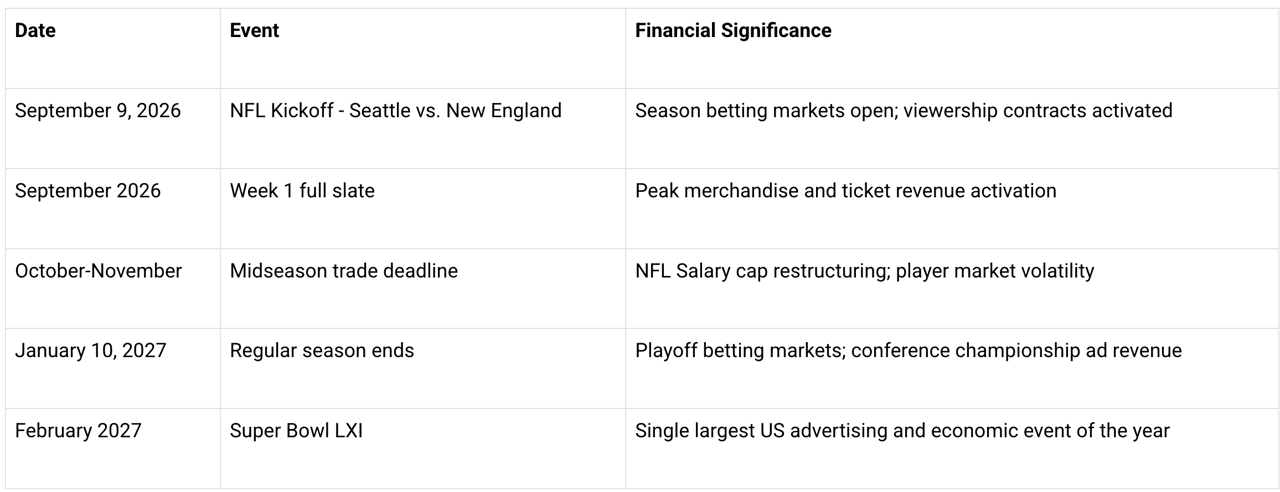
The NFL’s growing economic footprint extends far beyond the field, with record franchise valuations, a $301.2 million NFL salary cap and billions in media, advertising, stadium and consumer spending reinforcing its role as a major commercial force. As the 2026 season begins, the expansion of sports betting, fantasy football and prediction markets is creating further links between the NFL, businesses and financial markets. Together, these trends highlight how the league has evolved into a powerful economic ecosystem whose impact reaches well beyond sport.
This story was produced by Plus500 and reviewed and distributed by Stacker.
