
‘It’s a very dark time’: Inside Cornell’s surreal homecoming weekend

By Rob Picheta, CNN | Photographs by Heather Ainsworth
Ithaca, New York (CNN) — Worlds are colliding at Cornell. On the football field, the men’s varsity team is practicing for its homecoming game, the flagship event of their season. Players are fine-tuning routes and dapping each other up after a well-executed play. The school mascot dances past, a seven-foot bear pumping its paws in the air, and alumni groups mingle in a neighboring parking lot. Open a Cornell brochure: this is what homecoming looks like.
But here’s what it sounds like: clanging cowbells, and angry yells, and the sudden blares of a police siren. A few feet beyond the football field, student protesters are locking eyes with cops across a makeshift barrier, screaming at the officers from three feet away. The crowd swells and placards bounce up and down, the noise and fury drifting to the football field and through campus.
It’s been a month since Cornell was rocked by a lawsuit, filed by a former student identified as Jane Doe in legal documents, alleging she was drugged and gang raped at a Chi Phi frat house in 2024. The ensuing scandal, and a reopened criminal investigation, have ruptured the feeling of serenity that this remote, idyllic campus provides. Little has felt normal since.
Suddenly, these students are part of one of the biggest stories in the nation, and it’s taking a toll.
“You can feel it all the time: the tension,” says Harrison Beckwith, a sophomore on the student committee that canceled this year’s homecoming concert after its headline act pulled out. “In all my classes, you just feel a lot of sadness. A lot of uncertainty everywhere. Anger.”
It is a surreal time here. An entire population of students has suddenly found itself under a national microscope. Many are tired of the scrutiny, and it’s easy to understand why. They expected college to be fun, and none of this is fun.
But there are bigger forces at play; an entire system is under inspection too, and on that, students here are sharply divided. Many are fired up, hoping to seize this rare moment of outrage to change the way this centuries-old institution works. Nearly everyone is weary of the continued media presence on campus. Fraternities, silenced for now by a university ban on parties at frat houses, are nervously watching each other’s actions, aware that one wrong move could doom Greek life here for good.
And amid it all, a homecoming weekend. The university has tried to make the event look and feel like it does on pamphlets. It hasn’t worked: the undercurrent of anger and suspicion is everywhere. For this story CNN spoke to dozens of students, alumni and faculty members on campus this weekend, many of whom requested anonymity to avoid angering their fraternities, sororities or colleagues.
“It’s rough,” says Natalie, a senior who asked CNN not to publish her last name, about the feeling on campus. “A lot of people are getting fingers pointed at them.” The school, she says, is “punishing victims and students instead of targeting what needs to be targeted.”
“A lot of us care deeply about making a better environment and community,” she says – but she knows that change won’t come easily. “This isn’t the first time this has happened. It’s not going to be the last.”
Late last month, when Jane Doe’s lawsuit first spurred national outrage, Beckwith and his friend Gustavo Ponzoa realized they had a problem.
The two sophomores said they had spent months working to arrange Cornell’s annual homecoming concert, a fixture of the school’s social calendar. They estimate 1,500 students attended last year. But both of their phones were blowing up from inside and outside Cornell, and they predicted the email several days before it arrived: Between Friends, the headline act, was pulling out.
This isn’t the Cornell that Beckwith arrived at last year: he was happy to be at that one. “You feel a lot of pride, a lot of excitement,” he says, recalling his first weeks on campus. Those feelings changed when he read Jane Doe’s complaint, especially the vulgar messages sent by a fraternity member about “free p***y” in the house. It left both men disgusted and ashamed of their school. “Every step of the way, there was a failure,” says Beckwith.
New York’s governor has since appointed state Attorney General Letitia James to re-examine the case, and Cornell has retained former US Deputy Attorney General Sally Q. Yates to review how the school “prevents and responds to sexual harassment, sexual assault and related misconduct on campus.”
“There’s definitely a notable change in the atmosphere,” Beckwith says. “You don’t feel pride …you almost feel betrayed.” The past month, Beckwith says, “was a revelation.” He didn’t believe the actions alleged by Doe could take place at Cornell – but now, he says, he realizes that behavior is “among us.”
“It makes you so much more paranoid and distrustful of other people.”
Ponzoa chimes in, describing it as a “super gloomy” few weeks. “Every single day – even going to class felt rough.”
And now, the Ivy League school these young men strived to attend is one that seemingly no one wants to be associated with. “The next (concert) is straight up not happening. Who are we going to book?” asks Ponzoa. “Artists are worried about their safety (and) their brands.” He’s already heard “no’s” from musicians who were previously lined up, he says. “I don’t blame them. I would do the same.”
The canceled gigs include what would have been a celebratory 50th anniversary of a legendary Grateful Dead show at Cornell’s Barton Hall, a milestone in the histories of both the band and the school. Beckwith and Ponzoa both note that these are minor inconveniences in the face of much more serious issues. But they serve as reminders of just how far Cornell’s reputation has fallen.
Instead, the pair are looking to other pages of music history for inspiration. They are working to organize a show, featuring Cornell’s own student musicians, to raise money for the anti-sexual assault nonprofit RAINN. “There’s been so many instances of musicians fighting for what’s right, through concerts,” says Ponzoa – citing Joan Baez and the Live Aid concert among his lofty examples. “We want to be a part of that history.”
There are snippets of normalcy this weekend, if you look for them. Alumni receptions take place on campus, and Ithaca’s steakhouses and upmarket restaurants are booked through the night. In the Cornell store, Vickie Sparks cradles a pile of merch, including a mug reading “Cornell Mom,” her bashful son, a recent Mathematics graduate, in tow.
“I was conflicted about coming back,” says Sparks, from Berea, Kentucky. “I didn’t know how well we would be received. I didn’t know how comfortable I would be wearing my Cornell gear.” But their trip had been booked for a year, and “this horrible thing that has transpired was not going to make me change my plans,” she says. “We can’t let an incident, as bad and horrible as this was, be the only thing that Cornell is known for.”
But right now, it’s the only thing many people are thinking about.
For many of Cornell’s female students, the events of the past month haven’t just been traumatizing: they’ve been re-traumatizing. They remember the gossip two years earlier, when they were freshmen or sophomores, that something awful had happened at the Chi Phi house. Cornell is a large university, but when rumor spreads, any school can become a small town.
“I was on campus when it happened,” says Natalie, the senior. “You assume that the admin’s going to do something about it and support the student that needs support. Instead, we hear about it two years later, and nothing has been really done.”
“How do you know where to go from there?”
She talks while selling baklava in the foyer of the student union. Above her head and all around her is an elaborate mural, painted a century ago to depict the character traits of noble men. In Latin, an inscription translates to: “Nothing in the realm of men is alien to me.”
“Every woman on campus definitely has been a victim (of sexual assault or harassment), or has a friend who needed support,” Natalie says. She adds that she has friends who have filed complaints through Title IX, the federal civil rights law prohibiting gender-based discrimination, that have gone nowhere.
“It’s systemic, and it’s not gonna change overnight,” she says. But like so many students here, she is angry at the school’s leadership, and its embattled president, Michael Kotlikoff. “I don’t know if I trust anything that they’re doing,” she says.
“We understand why members of our community are asking questions about the university’s response in 2024, particularly in light of the deeply troubling allegations that have now become public,” Cornell told CNN in a statement Sunday. “Cornell took the reports very seriously and moved promptly to initiate its Title IX process. The university conducted an extensive investigation and adjudication over several months and imposed different sanctions based on the findings and circumstances involving each student.”
Two of the students named in Doe’s complaint were expelled, while others received lesser punishments. Two students, including one who was found responsible for entering the room where Doe was allegedly assaulted but not attacking her, were punished with directed study and writing reflection essays.
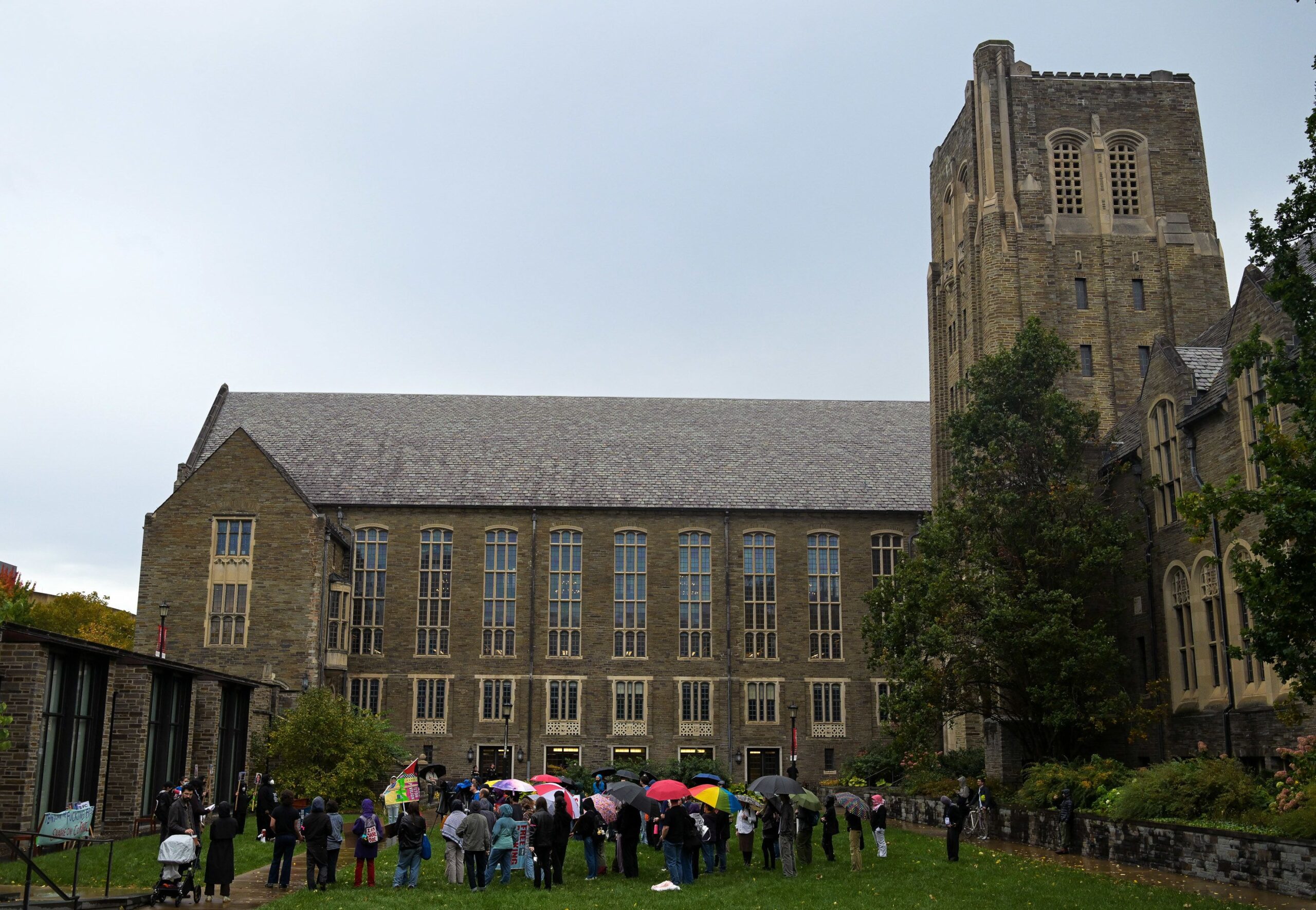
Outside, as gray clouds unleash a torrent of rain, a protest begins to form. These have been near-daily exhibitions of anger and frustration. Beneath umbrellas, attendees join a call and response: “There are no excuses!” and “No cover-up, no lies!” and “Ban the frats!”
“There’s a lot of anger,” says Gabe Sekeres, a doctoral student at Cornell, of the protest that he helped organize. “This is something that has been brewing for a number of years.”
“It was so clear from those messages that these men in Chi Phi felt as though (Jane Doe) was not a human. They truly dehumanized her,” he says. “It’s something that is endemic in fraternity culture. The university tells them that they are better than everyone else. They give a lot of money. They bring in a lot of money for the university. And as a result, they get to act with impunity.”
The Chi Phi national fraternity has condemned the alleged assault, saying it took actions in 2024 that “went beyond anything the law or Cornell University required of us.” Cornell shut down Chi Phi in 2024, and the fraternity is still prohibited from operating on campus.
Sekeres has long questioned the purpose of Greek life, a system he considers elitism and exclusionary. And now, he sees an opportunity to end it.
His protest swells to several dozen people and then takes off across campus, the attendees marching and clanging cowbells as they go. Eventually, university police contain the group behind a barrier and stand sullenly as protesters direct their angst towards officers.
Eeshaan Chaudhuri didn’t prepare for this. When he ran for president of the student assembly, he gave speeches to half-empty rooms about dining policies and the lack of free parking at the student health center.
“If you were to ask me, even a month and a half ago, what I thought my senior year would look like, I wouldn’t say it would (involve) speaking to CNN.”
But Chaudhuri, dressed in a charcoal suit and blessed with a politician’s ability to filibuster, could easily pass as a first-time candidate for a state legislature seat. He’s a bridge between students and the Cornell administration, and it’s difficult to imagine a time when that relationship has been more strained.
“The student body’s upset,” he says. “Sexual violence is a huge problem here at Cornell. And what (the) admin is doing right now to combat it is clearly not enough.”
Chaudhuri’s parents emigrated from India to the East Coast. His father had hoped to go to Cornell himself, and Chaudhuri lights up when he describes the moment he told his parents of his acceptance to the school. “I was able to achieve something my dad couldn’t do,” he says. “It’s been very humbling.”
But when he talks about his role today, his exhaustion is obvious. “I haven’t been to class in three weeks,” he admits: he has a mountain of homework waiting for him tonight, and his lecturers’ patience is wearing thin.
We meet in the backroom at Collegetown Bagels, a lively bakery-turned-bar that doubles as the go-to meeting spot for many undergrads. He knows that the life of everyone around him has been impacted, too.
“There are students here on campus that just want to be normal students. They want to go to class without having the media filming them. They didn’t ask for any of this when they applied to Cornell in the first place.”
But the exhaustion and the anger live side by side, and many students are directing their fury towards Kotlikoff, who last week said he was “deeply sorry for the harm Jane Doe suffered in 2024” and announced a range of new measures to increase security and support on campus.
He has resisted calls to resign.
Asked whether he supports those calls, Chaudhuri takes a beat for the first time, mentally sifting through the complicated realities of his role. “I wouldn’t be comfortable commenting on that at the moment,” he says at first. Then he admits that “Eeshaan, as a student, would call for the president to resign … absolutely.”
But Eeshaan the student politician isn’t so sure: a transition would slow down policy changes, he warns, and the problem is deeper than one man.
“I don’t think replacing the president of the university stops sexual violence,” he says.
It’s nighttime, and the frat houses are dark. At Delta Kappa Epsilon, in the parking lot, a group of guys underdressed for the cold are playing a three-on-three football scrimmage. “Kill, kill, kill,” they yell into the cool air. Nearby, EDM blares from another frat house, in spite of the tension around parties. Silhouetted figures are visible through the windows, and rowdy conversation bleeds through the walls.
And across the road, at the foot of a cobblestoned hill that cars sigh and grumble as they traverse, is the empty Chi Phi house. Students, walking heavy-footed down the slope, throw the occasional glance through its windows. This is Cornell’s grimmest new landmark.
What happened inside that Tudor-style building in October 2024 is the subject of a civil complaint and now a fresh criminal investigation. The house has sat vacant since Cornell concluded its own Title IX investigation and shuttered the frat. But it remains a monument to a swelling movement against the closed-door nature of many Greek institutions.
Some feel that movement has gone too far. Sienna, a sorority sister who asked CNN not to publish her last name, is one of few students willing to provide a partial defense of the seven students named in Doe’s complaint.
“I think that they were bad apples in a bunch,” she says. But the case is “revealing another issue with the American public,” she adds: “We’re morally determining their guilt. It’s ‘innocent until proven guilty,’ and that’s not what’s happened here.”
In her sorority, the mood has been “glum.” She says many freshmen and sophomores are wondering: “This (alleged rape) happened two years ago. Why is this (scandal) happening now?”
“We don’t want negative backlash. We don’t want to be identified, and blasted all over TikTok,” she says. Greek life, she says, is supposed to be “a positive experience for everybody. That’s why we pay thousands of dollars to be a part of it.”
Now, she walks to her sorority building past protests calling for Greek life to be shut down.
“They’re misunderstanding the way college life functions,” she argues. “If Greek life got banned, these boys – they’re not going away. If there’s a lot of horse deaths happening, are you gonna be like, ‘ban horse stables’?’”
“The issue is truly not frats,” Sienna says. “It’s just bad men.”
But according to many on campus, the issue is far more than that. They say a structure of secrecy operates within frats that protects bad behavior. That is a pattern that a frat member at Cornell, who spoke to CNN on the condition of anonymity, says he recognizes.
“Although it can be hurtful to hear people chanting ‘f**k the frats,’ I completely understand where their anger is coming from,” he says. “There definitely are problems with Greek life.”
“Everyone at elite institutions has the tendency to protect people in their circle,” he says. “Whatever happened in that house, the brothers were openly acting terribly, with so much malice, and I feel like if there was more public scrutiny, they would never have had the ability to commit the terrible things that they did.”
He feels the ban on frat parties is fair, and he’s willing to abide by it. But he’s not so sure about everyone else.
“I definitely have some concerns that other houses will not follow the rules, and essentially get Greek life banned on campus,” he says. Asked if someone, eventually, will slip up, the brother is unequivocal. “Oh, absolutely.”
Still, not everyone welcomes more scrutiny. Sienna argues there is a “good amount of oversight occurring” at frat and sorority houses. “It’s like, how much more oversight do you want on a college campus?” she asks. “At the end of the day, we’re teenagers and 21-year-olds … it’s not a secret that we wanna have fun.”
On Saturday, the chill rolls in. Winter here can be brutal, and this is its warning shot.
The mood on campus feels tense. Saturday is typically the biggest day of homecoming weekend, but today’s agenda is stripped down. Fraternities, which would usually throw crammed street parties in Ithaca’s Collegetown neighborhood, have been denied event permits by the city and urged instead to tailgate in the parking lot outside the 111-year-old Schoellkopf Field, surrounded by university police.
Already, fevered speculation has spread. A lengthy message, posted to the anonymous student message board app Sidechat, has gone viral: it warns that Cornell’s leadership has given frats one last chance, but “one f**kup from any chapter and it is likely Greek life is gone for good.” (A fraternity president confirmed that the message was an accurate summation of the university’s position).
It’s a triumphant day on the football field, where Cornell beats undefeated Lehigh in an upset. But most fraternity brothers aren’t watching. They’re back in Collegetown, filling the streets despite the ban on public events. For a few minutes, it looks like a normal celebration, at a normal time: students are drinking and laughing. And then the police wade in to shut down the gathering. The crowds, so full of defiance and angst a moment ago, disperse in minutes.
Many just wanted to have fun. But instead, a reckoning has split Cornell’s students.
“The frats hold a lot of power,” Ponzoa tells CNN. “Greek life has a big place here.” Cornell’s protesters allege that power has remained unchecked for years.
But now, the power may be shifting.
For weeks, Beckwith has felt little pride in his university. But then, after the shock of the complaint wore off, he started to find it in new places.
“I see so many students, at the protest, at the (student paper) Cornell Daily Sun, who are rising up, standing up and advocating. That’s inspiring to see,” he says.
“It’s a very dark time,” he admits. “But you see so much hope.”
The-CNN-Wire
™ & © 2026 Cable News Network, Inc., a Warner Bros. Discovery Company. All rights reserved.
