
‘Cake sheds’ are Britain’s new obsession and they’re popping up everywhere

By Lottie Gross, CNN
(CNN) — Something delicious and wholesome is popping up all over the British countryside, and people are traveling for miles to be a part of it. While America has roadside farm stands and fruit carts, Britain is now officially obsessed with cake sheds.
Honesty boxes — small wooden structures containing fresh, local produce like eggs or potatoes — have long been part of British culture. You drop your cash in a tin, take what you need and are on your way. Think self-checkout, old-school style.
They began as a way for farmers and smallholders to sell their produce directly to consumers in rural areas, reducing waste and providing extra income for the grower.
Today, though, they have morphed into something bigger, with Scotland leading the way with unique takes on honesty boxes — you can buy artwork, pottery and even dog-paw balm in some of Scotland’s more unusual iterations.
But cake sheds are a relatively new and far sweeter trend taking the British countryside and its suburban communities by storm in 2026, creating a nationwide “Great British Baking Show” anyone can be part of.
Hard work
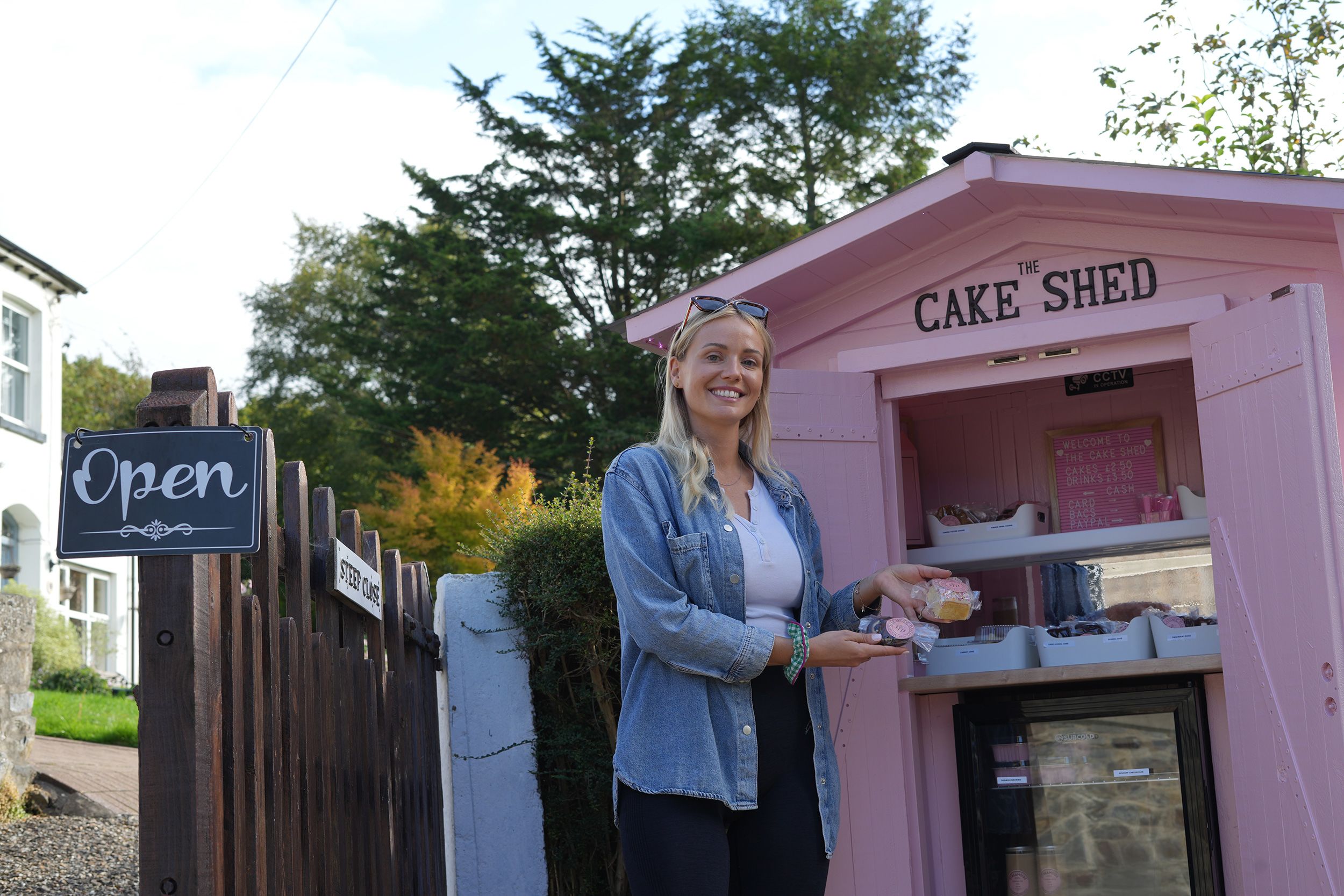
The concept of a cake shed is simple: a home baker makes their favorite cakes, portions them up in small bags or boxes, then leaves them inside a small shed-like structure at the end of their driveway or in their front garden.
Visitors to the cake shed can then help themselves and leave the required cash in a tin, pay by QR code or punch the amount into a card machine.
But while the idea is simple, the operation isn’t always as easy. Aside from requiring a food hygiene certificate and public liability insurance, it can be immensely hard work.
After a full week at work as a carer in a Devon retirement home, Michelle Evans returns to her kitchen on a Friday night and immediately gets baking. Her shed, which sits on a wall at the bottom of a close family friend’s garden, is located right on the South West Coast Path in Devon.
This popular trail sees nine million visitors a year exploring some of its 630 miles of meandering cliff paths and beach boardwalks, and so Evans’ shed is in prime position for passing walkers taking in the trail around the historic maritime village of Appledore.
She bakes on a Friday night to fill the shed for a Saturday morning, and regularly stays up until 11 p.m. to ensure she’s made enough. Across the weekend, she will bake up to 150 portions of cake, from local favorite lemon drizzle to sheet cakes like rocky road and millionaire’s shortbread. “It’s hard work, but I love it,” she says.
With her cakes priced between £2.50 and £3 (between $3 and $4), she can make up to £450, or about $590, in a weekend if she sells out — which she usually does.
But she says it’s not about the money: “My grandmother, Wyn, who the shed is named after, used to have a bakery in Appledore and everybody knew her. So I’m continuing a family tradition.”
Spreading ‘like wildfire’
Evans’ shed, which has been running consistently for 18 months, is very much a family business. Her son helps her set up the bakes in the mornings, and her daughter is in charge of the social media side, telling everyone what’s in the shed and where they can find it.
According to the founders of cake shed directory website cakesheds.com, Mark and Michelle Percy, social media has played a huge part in this trend taking off. “I think more and more cake sheds have started popping up and social media has really helped them spread like wildfire,” says Michelle.
“They’re such a lovely thing to discover and incredibly easy to share online, so one person finds a cake shed, posts about it and suddenly lots of other people know about it.”
Their directory, which was launched in April 2026 in response to the increasing number of cake sheds appearing on roadsides, has over 300 cake sheds listed.
“We’ve always been big dessert people, so when a local cake shed opened up in our village, we were really excited,” Michelle adds. “We’d seen a few popping up here and there and started wondering just how many cake sheds were actually out there.”
Location is key
Social media has also helped former teacher Jenna Powell launch and maintain her cake shed business, which is open daily from morning until night in Swimbridge, Devon. She’s got a sophisticated set-up with a card machine, a fridge for iced coffees and a live camera. It’s become so successful that she’s even been able to leave her part-time job to make baking her sole form of income.
“I’ve never not had a customer, which is amazing. People hold themselves back thinking that they can’t do it and obviously, it’s a really scary leap. For two years I felt like I couldn’t live without a steady income that’s guaranteed, but the cake shed has got busier and busier because I can give it my all now.”
Location is key, too, she says. “I’m right next to a school, so the afternoon school run is a bit of a rush, and our road used to link two big towns before the ring road was built, so many people still use it to get to work.” The shed is perched on the end of her driveway, elevated above the footpath and decorated with fairy lights and flowers. “It advertises itself,” she says.
Of course, the quality of the bakes helps, too. So-called “school cake” is Powell’s best-seller, a traditional vanilla sponge with white icing and sprinkles on top that has been a staple for children in British schools for generations.
But she also serves cheesecakes, tiramisu brownies and cinnamon rolls to pair with pumpkin spice iced coffees in plastic takeaway cups. She says she has only had to leverage the security camera once when a young local boy decided to try his luck at stealing a few cakes for his friends. She knew the boy’s mother, and so it all ended amicably and the cakes were eventually paid for.
Sweet mystery
Why cake sheds have taken off in such a way this year is something of a mystery, but food historian Annie Gray says it’s possibly a response to our changing world: “Small pleasures and inexpensive treats in times of economic uncertainty are clearly part of it,” she explains.
The “Great British Baking Show” (or “Great British Bake Off” as it’s known in the UK) has been an influence for some home bakers, too.
Elizabeth Hudson has a cake shed based in Egham, Surrey, around 19 miles from London. “GBBO has been a great inspiration throughout my entire baking career,” she says.
“In early 2021 I applied to be a contestant on the show, and though unsuccessful, it drove me to set up my baking business from home later that year. Baking always brought me joy and I wanted to bring that same feeling to others, now I can do that on a weekly basis with the shed, taking inspiration from GBBO to challenge myself each week to create exciting new bakes.”
Similarly, the “Great British Baking Show” is helping some cake sheds stay relevant. Emma Sawyers launched her cake shed in rural Norfolk, in the east of England, in May 2026 and uses the TV show to inspire her weekly menu.
“I have always followed the Great British Bake Off, and I just thought, why not pick one of the bakes they do on the show each week and pop it in the shed?” she says. “They sell out every week and I love the challenge.”
Cake sheds appear to be offering more than just sweet treats, though. Much like the thriving honesty box culture in Scotland, the cake sheds that have popped up over the last six months appear largely to be run by women. For many, they are a way of remaining economically active in a way that is flexible around parenting and caring responsibilities.
“On the one hand, it is lovely to see small-scale home bakers being able to find outlets for their undoubted skills, and to see something reliant on honesty in a world that seems increasingly cynical,” says Annie Gray. “But on the other hand, I am not that sure we need much more cake.” It appears the British public disagrees.
The-CNN-Wire
™ & © 2026 Cable News Network, Inc., a Warner Bros. Discovery Company. All rights reserved.
