
Politics can be stressful, but voting may help you live longer
Links between voting and longevity may be due to various factors

By Kristen Rogers, CNN
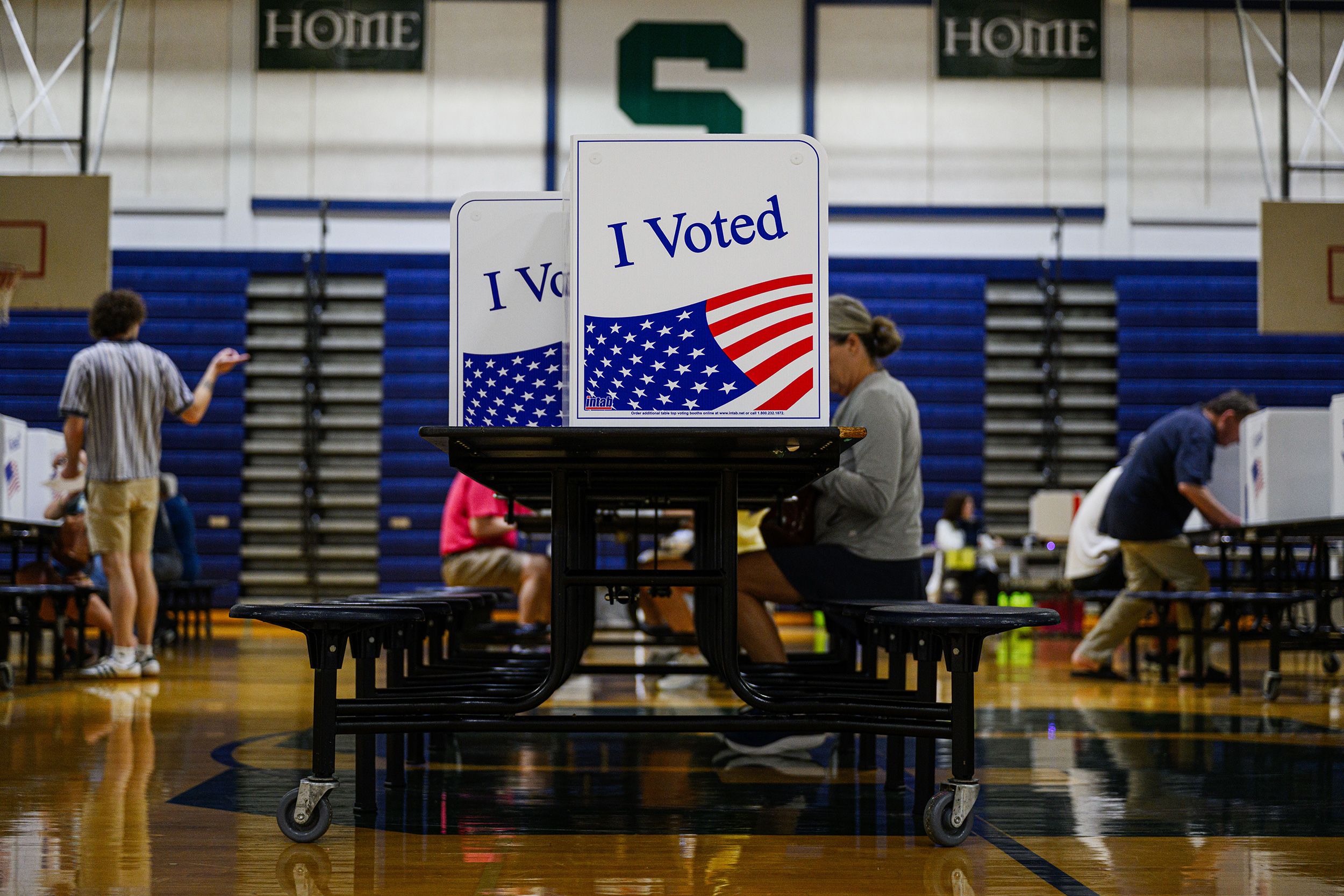
(CNN) — As millions of Americans vote in the midterm elections, a first-of-its-kind study suggests that voting may accomplish more than fulfillment of your civic duty — it may also indirectly reduce your risk of dying early from any cause.
Voting in the 2008 and 2012 US presidential elections was associated with roughly a 26% and 32% lower risk of premature death by 2023, respectively, according to the study published in March in The Journals of Gerontology: Series B. Its most comprehensive findings are based on the health and objective voting data for about 4,200 older adults from Wisconsin.
“You should vote as a civic duty, but doing your civic duty actually has benefits,” said first study author Dr. Femida Handy, who focuses on philanthropy as a professor in the School of Social Policy and Practice at the University of Pennsylvania. “Understand voting as not being a magic pill that’s going to make life longer, but it raises the possibility that it provides some certain psychological benefits.”
Happiness, altruism, optimism, social connection and a sense of belonging and purpose all have been linked with longevity in previous studies. And the American Medical Association has acknowledged voting as a social determinant of health.
The little prior research on any sort of relationship between voting in the United States and living longer largely examined how health status might predict later voting behaviors, Handy said. Or studies looking into how voting may predict future health outcomes relied on self-reported voting information, whereas the current research used verified records from Catalist, a national voter file database.
The study by Handy and her coauthor, social psychologist Dr. Sara Konrath, cannot prove that voting led participants to live longer. Those with lower early death risk were also more likely to be women and younger, and to have more financial and health resources.
Effects of electoral engagement
The participants, most of whom were White, were part of the Wisconsin Longitudinal Study, a long-term health and social sciences study of more than 10,300 people who graduated from Wisconsin high schools in 1957. By 2023, the last year that the authors of the new research collected mortality data, the participants were 84 years old on average.
People who voted in 2008 had a 45%, 37% and 29% lower risk of early death after five, 10 and 15 years, respectively — regardless of whether they voted remotely or in person, though the latter typically had a slight advantage. The researchers also found that while voting in 2012 carried a 32% lower risk of early death, participating in the 2004 election was not associated with lower or higher odds — and the reason why is unclear.
These findings generally stood regardless of political affiliation, financial resources and the health measures the authors accounted for — which included smoking, alcohol consumption, functional limitations, vision, hearing, speech, pain, emotional well-being and memory. The researchers didn’t have details on participants’ disease status, physical activity, diet or sleep, but the measures they did use “correlate very highly in other research with objective health outcomes,” Handy said.
Any connection between voting and longevity would be due to other factors attendant to the act, said Dr. Benjamin A. Rein, clinical assistant professor in the department of psychiatry at the University of Buffalo in Buffalo, New York.
“There’s something about a will to be alive that keeps people alive,” added Rein, who wasn’t involved in the study and is the author of “Why Brains Need Friends: The Neuroscience of Social Connection.” Someone may not vote unless they see themselves in the future, one they want to help shape, Rein said.
And “even voting remotely, you feel like you’re part of a group. You’re important. You have agency,” Handy said.
“All of that will tell me that you will do better off than somebody who says, ‘I’m not voting because I don’t believe in it,’” Handy added. “They’re not prosocial.” And that attitude may be present in other areas of their life as well.
Since the study consists of people from Wisconsin, there may have been key local issues that motivated their electoral participation or had some relationship to their health, Rein added — which may factor into the lack of associations between mortality and voting in 2004.
The geographic and racial limitations of the study also mean it’s unknown what the results of similar research on people of other races, ethnicities and locations would be — often critical factors in one’s relationship to politics, whether the individual is prosocial or not.
The exclusion of elections after 2012 was because the point at which the authors could obtain data on mortality risk up to 15 years later, as they did for the three elections, hasn’t yet arrived.
And it’s worth noting that 2008 “was a very different political atmosphere,” Rein said. “Now we’ve tied a lot more division to politics that could be unhealthy. And I’d be very curious to see if this result holds up with the 2020 election, for instance, or 2024.”
The-CNN-Wire
™ & © 2026 Cable News Network, Inc., a Warner Bros. Discovery Company. All rights reserved.