
Jensen Huang is living proof that AI’s rockstar CEOs are also a hidden risk

By Matt Egan, CNN
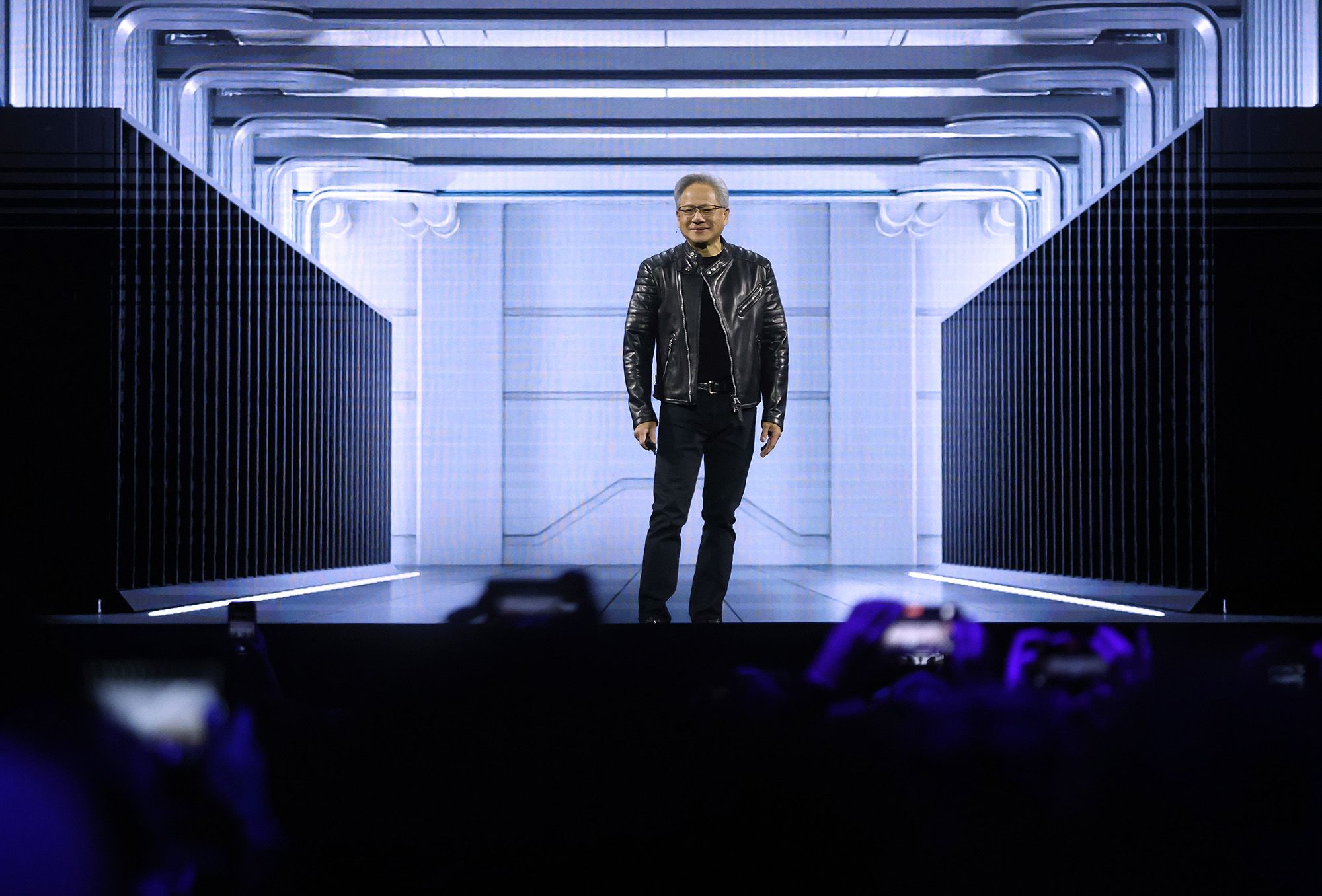
New York (CNN) — Jensen Huang is not just the face of Nvidia. He’s arguably the most important person in the most critical industry on the planet.
Huang masterminded Nvidia’s meteoric rise into a $4.5 trillion behemoth at the heart of the artificial intelligence boom. Huang is its irreplaceable hype man, conduit to the White House and foreign capitals, and super hero who comes to the rescue by putting out fires in the AI trade on Wall Street.
But the Nvidia CEO now finds himself at the center of a stunning scandal sending shockwaves across Wall Street, Washington and Silicon Valley over his admitted affair with an executive who was reportedly working with Chinese intelligence.
The controversy lays bare a major but often overlooked vulnerability in the AI boom: The fortunes of many of these unthinkably powerful companies are inextricably linked to a single person.
So-called “key man risk” is not just an obstacle for Nvidia:
- Both Tesla and SpaceX revolve around CEO Elon Musk, the richest person in the world.
- OpenAI is almost synonymous with Sam Altman, its mercurial CEO.
- Meta co-founder Mark Zuckerberg’s fingerprints are all over virtually every major move made by the Facebook and Instagram owner, another major AI player.
- And Anthropic CEO and co-founder Dario Amodei’s doomsday warnings about AI safety have made him the face of the AI lab as it attempts to pull off a $1.5 trillion IPO.
“Key man risk has never been more of a blessing and a curse,” Dan Ives, partner and senior managing director at Yorkville Ives & Co., told CNN in a phone interview. “We’ve always had powerful CEOs but never in history have we been at a point where such an important industry is run by people you can count on two hands.”
The nature of AI – incredibly complex, secretive and specialized – makes it especially susceptible to one-person rule.
“When you think about CEOs who can see around corners, they don’t grow on trees,” Ives said.
‘Solar system model’
Jeffrey Sonnenfeld, the Yale professor known as the “CEO Whisperer,” said he’s fine with founders having outsized voting power, but stressed that companies “can’t surrender all control.”
“These companies have created a solar system model of leadership and that can be problematic. You need to build bench strength,” said Sonnenfeld, who has studied CEO succession and whose Chief Executive Leadership Institute last year honored Huang with its Yale Legend in Leadership Award.
Nvidia’s board investigation into Huang exposes a major weakness: There is no obvious bench of talent who can quickly be tapped to replace him, if needed.
“There is no board succession plan, which is extraordinary. Jensen has bragged about having 60 direct reports. That’s crazy,” said Sonnenfeld.
Why succession planning matters
It’s a stark contrast to the leadership model at other companies that have focused intensely, with varying degrees of success, on building a bench of talented executives who could take over if a scandal, health emergency or other sudden event forces the leader out.
For instance, JPMorgan Chase has built such a strong roster of experienced talent behind longtime CEO Jamie Dimon that the company regularly loses top lieutenants to rivals on Wall Street.
But SpaceX recently warned investors that the company is “highly dependent” on Musk’s continued service and performance.
“The loss of Mr. Musk, whether due to death, disability, or otherwise, or his inability or unwillingness to continue in his current roles,” SpaceX wrote in a filing, “could significantly disrupt our management structure, adversely affect our ability to execute our strategic plans, and negatively impact our reputation and relationships with customers, partners and other stake holders.”
While Nvidia’s most recent annual financial report to regulators does not directly spell out how much the company’s fate is linked to Huang, the filing does note the company is “highly dependent” on the services of its executive team. It also acknowledges that “failure to ensure effective succession planning” could “hinder our strategic planning, execution and long-term success.”
AI’s everything man
Huang prides himself on being an indispensable part of Nvidia’s incredible rags-to-riches story, a tale that began at a Denny’s in 1993 and has morphed into one of the world’s most valuable companies.
Time and again, Huang has emerged as the most powerful force in this turbulent industry.
When AI safety fears rocked Washington, Huang was front and center as President Donald Trump explained how the industry can police itself.
When worries about cheaper open models from China sparked selling in global markets, Huang teamed up with Wall Street power players to cobble together a $500 billion plan aimed at keeping the flow of money pumping into AI-powering chips.
Huang has also served as the AI industry’s ambassador on the international stage. He recently met with leaders in European capitals, pitching them on the idea of sovereign AI, where every country needs to build and control its own AI systems.
And Huang has presided over Nvidia’s effort to build out the AI ecosystem. In September, the company disclosed a staggering $99 billion worth of equity investments in this space, up from $2.2 billion two years ago.
“Jensen is the global face of AI. You can’t replace him with one, two or three other candidates,” said Ives. “He’s not just a CEO, he’s the most powerful person in the world in the AI industry.”
Huang often speaks about how he’s repeatedly saved Nvidia from near–death experiences. He even built one of the company’s internal mottos around that theme: “Our company is thirty days from going out of business.”
‘Like a James Bond movie gone horribly wrong’
That’s why the past couple of days have been such an earthquake.
Nvidia’s board of directors said Sunday it is investigating reports that Huang was the “target of a foreign intelligence effort.”
Huang admitted to having an extramarital affair, saying he was “unfaithful” and that his actions hurt his wife and children.
“I take full responsibility for what I did and the hurt I caused, and I accept the criticism that comes with it,” Huang said, adding that he supports Nvidia’s investigation.
While Huang did not name the other person in the affair, US officials reportedly suspect that individual fed intelligence to China and helped smuggle advanced AI chips into that country.
“I’ve seen everything covering tech for 30 years, but this is a shock. It’s just mind-boggling for investors,” said Ives. “It’s like a James Bond movie gone horribly wrong.”
‘If he was any other employee….’
Sonnenfeld sees only a 50/50 chance that Huang keeps his job. The Yale professor questioned how Huang will continue to simultaneously run Nvidia while facing multiple investigations from his board and various congressional committees.
Sonnenfeld said it’s possible Nvidia’s board decides to elevate Huang out of direct management by giving him a symbolic role for the sake of continuity.
Another option, according to Sonnenfeld, could be to bring in an experienced former tech CEO who has a deep understanding of AI, such as former Google CEO Eric Schmidt.
“The board could come up with alternatives to avoid being held hostage,” Sonnenfeld said. “If he was any other employee, he’d be fired. But he’s just so central. His name is bigger than Nvidia’s.”
The-CNN-Wire
™ & © 2026 Cable News Network, Inc., a Warner Bros. Discovery Company. All rights reserved.
CNN’s David Goldman contributed reporting.