
My smartphone wrecked my wrist. Here’s how

By Antoinette Radford, CNN
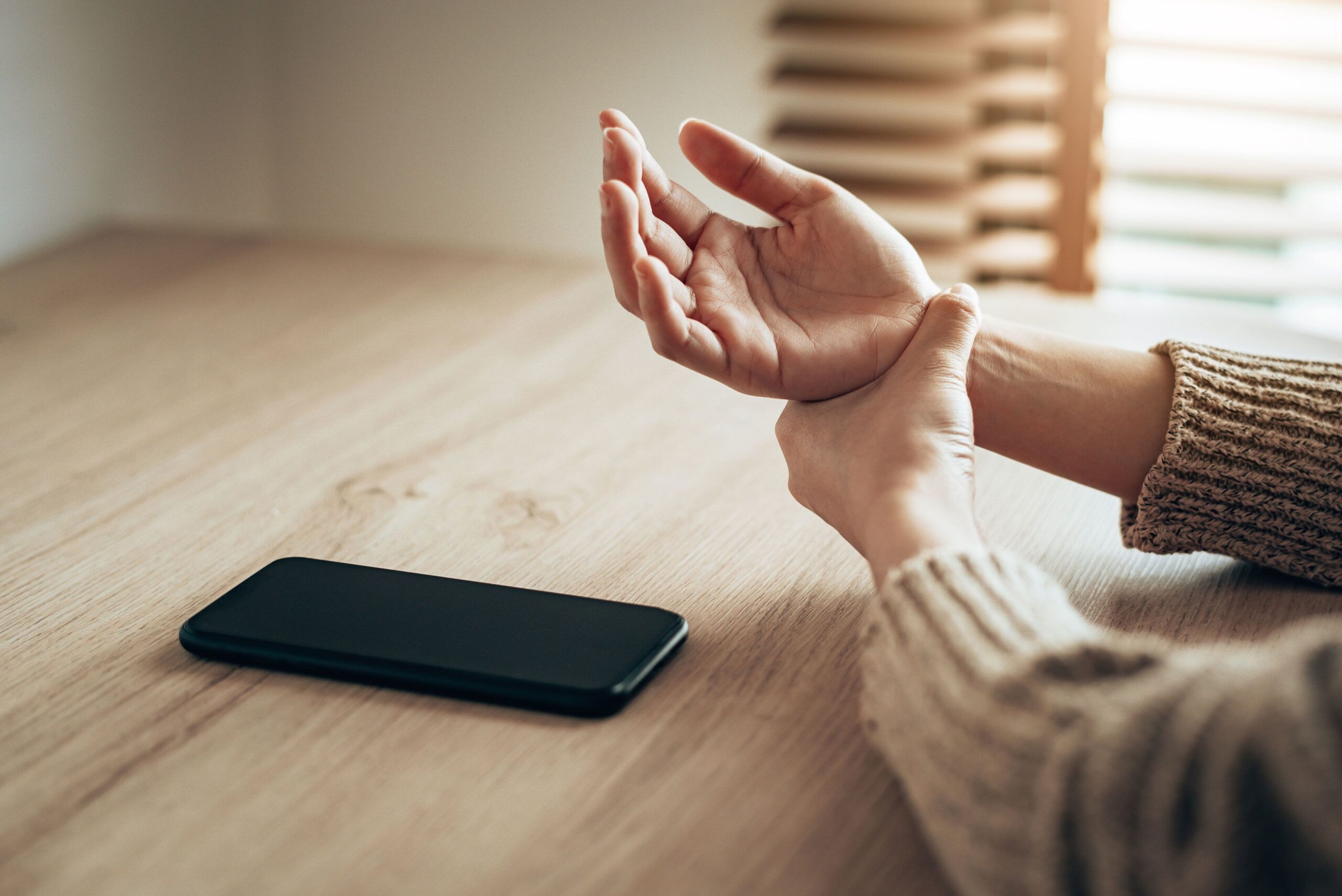
(CNN) — It started as a dull ache in my right wrist. Maybe I’d been working out too hard at the gym. So, I stopped lifting weights with my right arm.
Then the pain happened again. Had I carried too many heavy bags? Or tripped and fallen on my wrist? No, I hadn’t done anything like that.
I went to work one morning and started typing on my keyboard, and it got worse.
That’s when I realized that perhaps I hadn’t injured myself in a single incident. Maybe I had been using my smartphone, or really, overusing it.
Our hands are made up of tendons, small bones, muscles and nerves that pass through one central area: the wrist.
And hands and wrists are particularly susceptible to damage from the thousands of tiny micromovements we do each day — especially when actions such as typing on a phone become so repetitive.
There are three main conditions linked with excessive smartphone use. Trigger finger occurs when the tendon that helps your fingers bend becomes inflamed, so it gets stuck in a certain position. De Quervain tenosynovitis is a condition in which the two tendons along the thumb become swollen and irritated. And carpal tunnel syndrome happens when the major nerve that goes to your hand becomes compressed at your wrist.
And while it may not be considered a medical condition, “smartphone pinkie” can also result from repetitive motions. It’s a temporary indentation in your little finger that comes from holding your phone in your hand.
Dr. Ariel Williams, an orthopedic surgeon specializing in hand and upper extremity surgery at Yale Medicine, said she’s treating an increasing number of patients who say their mobile phones have aggravated their symptoms or their issues started with some change in their mobile phone use.
“It is probably a combination of the repetitive motions we engage in when we are using our phones and also being in a particular position for a prolonged period of time,” said Williams, who is also an assistant professor of orthopedic surgery at Yale University School of Medicine.
“All those things put increased stress on our bones and joints and ligaments and tendons and can also cause changes that end up causing increased pressure on our nerves.”
But it’s too soon to tell whether the technology most affects hands or wrists.
“This is a problem that impacts both our wrists and our hands and even sometimes problems that we see originate from our elbows,” Williams said. “Our wrists and hands are so complex, and there are so many infinitesimal motions that happen over and over again, and every time we scroll or we send a text … those things just cause cumulative strain over time.”
The impact on the neck
But it’s not just our hands and wrists that are affected. The neck is another part of the body that comes under significant strain from constant interactions with technology. Tech neck is the term for the symptoms associated with this pain.
These symptoms include pain at the back of the neck, aching or tightness around the back and sides of the neck, stiffness and a reduced range of motion in the neck as well as headaches.
This condition is something a lot of people need to pay attention to, said ergonomic physical therapist Kelly Robinson, who is based in Dubai, United Arab Emirates.
People are increasingly conducting most of their daily business on their phones, especially with the advent of artificial intelligence, Robinson said.
“So, the smartphone and the laptop is just in everyone’s life,” she said, “whether it’s in your personal life, in your work life, probably both.”
Tech neck can lead to headaches and fatigue
Technology’s impact on our necks can be pronounced. The neck houses multiple important nerves and neural pathways so tech neck can lead to headaches and fatigue, and every time you bend your neck forward, it puts significant pressure through the nape.
“They’ve actually done quite a lot of research on this,” Robinson said, “and what they’ve shown is even with an increase in 10 or 20 degrees of your neck angle, looking downwards at a phone, for example, you are increasing the load on your lower neck, on the joints.”
“So if my head is simply at a 30-degree angle down, I’m increasing the loads on my neck structures by three times, which is up to around 15 to 20 kilos on my neck.”
How to prevent these conditions
Some prevention tips to ease tech-related pain are simple enough to incorporate into your everyday life, Robinson said.
Become more ambidextrous: Constantly holding a phone in one hand puts all the pressure through that hand and can cause repetitive stress injuries. Try sharing the load with your other hand. It’ll split that pressure between the two hands.
Tuck in your chair at your desk: Tucking in your chair can make all the difference when it comes to posture. Leaning away from your desk brings your neck and back down and rounded. Tucking in your chair automatically brings your neck up — provided you have the tools required in the next step.
Get a laptop stand: Bring your laptop to your eyeline to avoid looking down. A wireless keyboard and mouse help, too. That way you don’t have to keep your arms or eyes at awkward positions.
Activate your back muscles: A banded row can help activate your back muscles before you sit at your desk for a whole day. Doing so keeps your body more upright instead of falling into a hunched position.
Stretch your hands behind your back: Link your hands together behind your back and lean forward, which will stretch out your upper back and help keep your head back.
The-CNN-Wire
™ & © 2026 Cable News Network, Inc., a Warner Bros. Discovery Company. All rights reserved.