
UCLA studies link climate change to rising homelessness
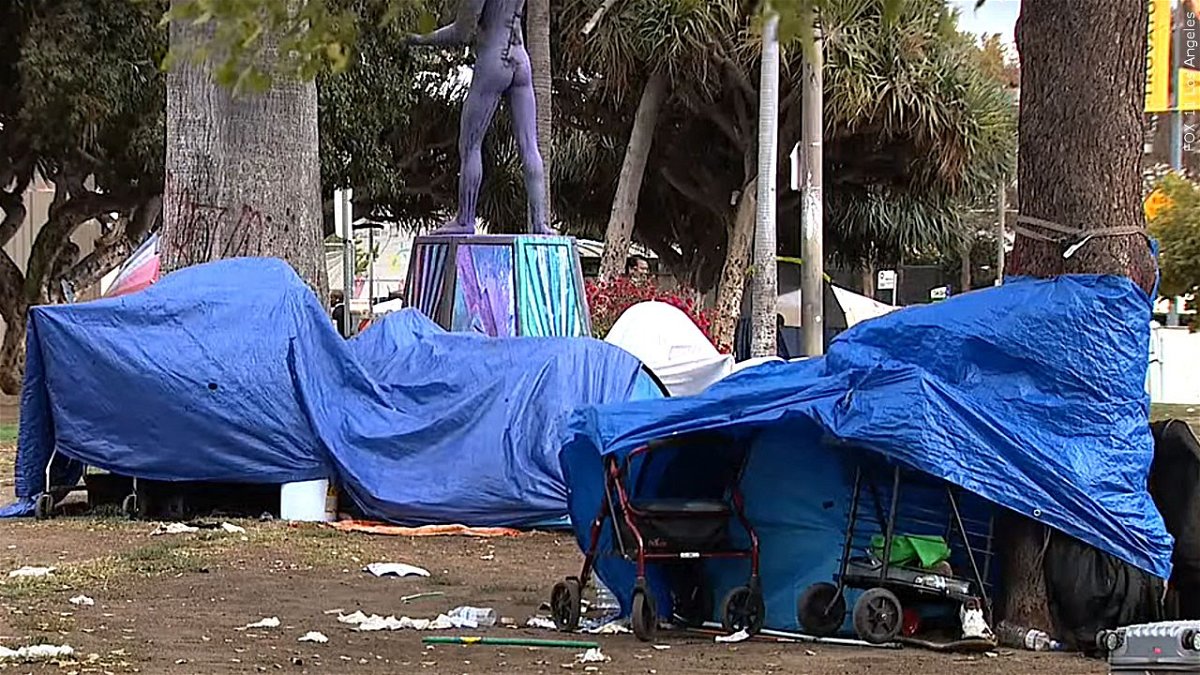

LOS ANGELES (KESQ) - Research led by UCLA suggests climate change and natural disasters are driving increases in homelessness across the United States, with experts warning that housing stability must be a central focus of disaster response, it was announced Thursday.
The findings come from four recently published peer-reviewed studies examining homelessness nationwide and in Los Angeles County, including the impact of the 2025 wildfires and broader links between displacement and housing loss, according to researchers.
"Each home lost to climate-related events, per 10,000 people, was associated with a significant, 1 percentage point greater increase in homelessness,'' Dr. Kathryn Leifheit, assistant professor in the UCLA Fielding School's Department of Health Policy and Management, said in a statement.
"Our findings underscore the reality that homelessness can be seen as a predictable consequence of climate disasters, so governments should focus on housing stabilization in their disaster response plans, while dedicating adequate funding to provide housing-specific services."
In Los Angeles County, where more than 52,000 people are unsheltered on any given night, researchers said the 2025 wildfires displaced roughly 200,000 residents and severely affected people already living on the streets.
"The wildfires were among the most devastating urban wildfires in history, and as traumatic as they have been for those who lost their homes, those living on the street suffered as well,'' said Dr. Randall Kuhn, professor in the UCLA Fielding Department of Community Health Sciences.
Researchers said policies aimed at preventing evictions and stabilizing housing can significantly reduce homelessness.
"If states and local governments had allowed evictions to proceed during that period, we estimate that the average increase would have been nearly 20%,'' said Dr. Craig Pollack, a professor at the Johns Hopkins Bloomberg School of Public Health.
Additional findings showed that enforcement measures such as homeless encampment sweeps and laws targeting behaviors like sleeping in public are linked to worse physical and mental health outcomes.
"Policing doesn't work,'' said Dr. Benjamin Henwood, a researcher at the USC Suzanne Dworak-Peck School of Social Work. "The physical and mental health damage is both immediate and cumulative, and in many cases, just moves the individual from one spot to another -- it doesn't really solve the problem."
The research also highlighted the need for stronger collaboration between emergency response systems and homeless services.
"These findings, and the realities that climate change is very likely to lead to even more of these sorts of disasters, highlights the need for even more coordination between emergency response systems and homeless services, to ensure that everyone is adequately protected during future disasters,'' Kuhn said.
The studies were published in the April editions of the Journal of the American Medical Association's JAMA Network Open and the American Journal of Public Health, as well as the March editions of Health Affairs Scholar and Social Science & Medicine.
