From e-cards to virtual worlds: 30 years of digital Christmas


Takoyaki Tech // Shutterstock
For as long as we’ve had the internet, we’ve been using it to celebrate the holidays.
If you’re an elder millennial or Gen Xer, you probably still remember the early rituals well: sending laughably pixelated e-cards, posting seasonal greetings on message boards, rushing home to change your AIM font to holiday colors after school. Perhaps you painstakingly decorated your GeoCities page with HTML snowfall and a looping MIDI soundtrack of “Carol of the Bells.” Or maybe you’re a Gen Z digital native who grew up on a diet of YouTube Christmas concerts and Elf Yourself videos. Born squarely in the online era, you’ve never known a holiday season that wasn’t celebrated, in one way or another, on a device.
Over the years, we’ve watched the internet evolve from clunky and dorky to delightful and, well, everywhere. Today, online holiday shopping generates $282 billion in the U.S. and $1.2 trillion globally, according to Salesforce data. In 2024 alone, $229 billion of that online holiday commerce was influenced by AI tools and recommendation engines, which shows just how ingrained digital behavior is in how we celebrate.
However distorted those primitive graphics look to us now, the internet’s onset undoubtedly marked something huge. It was the first time people could share holiday moments with loved ones without being in the same room, or even online at the same time. And as the web matured, our digital holiday habits leveled up with it. Suddenly, December wasn’t about waiting for someone to check their email, but rather experiencing real-time festivities in virtual spaces. Livestreamed concerts replaced those tinny MIDI files, synchronous group video chats took over from digital greeting cards, and people began connecting across states, countries and time zones.
To understand how we got from e-cards and decked-out webpages to the way we now use the web to orchestrate real-time virtual celebrations, Decentraland dug into three decades of internet archives from cultural sources like Reddit, The Atlantic, ABC News, Smithsonian Magazine and more.
The timeline that emerges is oddly tender, unexpectedly funny and instantly nostalgic to anyone who’s grown up alongside the net.
1990s: Message boards, e-cards, and early online shopping
Message boards and forums
In the early 1990s (and even late 1980s), the holiday season started seeping onto the web through message boards and text archive files. Sites like Textfiles.com now preserve folders of seasonal poems, jokes, and parodies, hosted in a folder called “Holiday Textfiles.” These pieces come from the wider bulletin board system (BBS) and early message-board culture, where people shared text files digitally long before the modern web. Both were precursors to the World Wide Web and today’s social networks. Text file titles such as “The Worm Before Christmas” and “The Twelve Computerized Days of Christmas” show that festive digital sharing started earlier than most people remember. These were simple and asynchronous moments of connection, but they marked the first shift toward celebrating together through screens.

Decentraland
Early online greetings
E-cards came next. In December 1994, The Electric Postcard, one of the first web-based greeting card sites, let users choose an image, write a note, and send a link by email. It handled up to 19,000 cards a day by Christmas 1995, and by spring 1996 had delivered more than 1.7 million, reported The Atlantic. After that moment, e-card platforms exploded in popularity, with BlueMountain.com (founded in 1996) quickly becoming one of the most visited websites on the internet. In October 1999, Excite, a leading search engine in the late 1990s, agreed to acquire BlueMountain.com for approximately $780 million, reported The Guardian. With these developments, sending a holiday hello ceased being bound by postal schedules or geography: You could reach someone instantly, no matter where they were.
Festive personal web pages
As more people built personal homepages on GeoCities or AOL Hometown, they started decorating their sites for the festive season with blinking lights, looping MIDI carols, drifting snowflakes, and novelty GIFs. The preservation project One Terabyte of Kilobyte Age wrote in a blog: “Up until today we discovered 55 pages in the GeoCities archive that were decorated with softly falling DHTML snowflakes… adapting JavaScripts that GeoCities users copy-pasted into their pages, digging up missing snowflake GIFs and other flying objects…”—a reminder of how much care people poured into these small online corners.
Early online Christmas shopping
By the late 1990s, people’s behavior on the web shifted from sharing to shopping. Research published in ScienceDirect shows consumers spent about $1.5 billion online during the 1998 Christmas season. The next year, spending jumped from $5 to $6 billion. Ernst & Young’s 1998 retail survey showed that the share of shoppers who did at least 10% of their holiday shopping online was expected to almost triple in just one season. Buying gifts on Amazon or eBay was no longer an odd experiment, but rather a normal part of December.

Decentraland
Early 2000s: Virtual worlds, Flash, and festive SMS
Holiday events in virtual worlds
By the early 2000s, holiday traditions had already found their way into online worlds. Games like RuneScape introduced festive moments that players could experience together, such as its 2001 Christmas event, where Christmas crackers were scattered across the map. Around the same time, Habbo Hotel showcased seasonal furniture and decorated social rooms, turning the virtual hotel into a kind of digital December hangout. Club Penguin’s first Christmas Party launched in 2005 and offered players Santa hats, scarves, and fully themed locations from the Night Club to the Ice Rink. This showed that there was an appetite for celebrating the holidays together online, even inside simple virtual spaces, long before virtual concerts and in-game festivals took off.
Flash e-cards and quirky interactive websites
Holiday expression took on a new form with the arrival of Adobe Flash, a software that made it easier to create animated and interactive webpages. Platforms like JibJab and Hallmark’s online greeting tools let people star in their own animated cards. Then came Elf Yourself in December 2006, a campaign by OfficeMax that let users turn their faces into dancing elves. Elf Yourself exploded almost immediately with more than 36 million visits and 11 million elves created in its first five weeks, reported MediaPost. These were early hints of the internet’s taste for viral seasonal spectacle that’s interactive, customizable, and made to be shared.

Decentraland
YouTube enters the chat
The launch of YouTube in 2005 added something new to the season: user-generated holiday videos. From homemade light shows synced to music, to comedic Christmas sketches, to early vlogs capturing family traditions, a new channel for expression had been unleashed. One of the earliest viral examples was Ohio engineer Carson Williams’ Christmas light display set to a soundtrack by the Trans-Siberian Orchestra, which was recorded in 2004 and circulated online in 2005. YouTube made the holiday season feel more public because a single person’s festive video could take off and become part of everyone’s December.
Holiday text messaging peaks
As mobile phones became more common in the early 2000s, holiday greetings shifted again. The very first text message, sent on Dec. 3, 1992, read “Merry Christmas,” but it wasn’t until the mid-noughties that SMS became a defining December behaviour. By 2005, O2 reported that 65 million texts were sent through its network on Christmas Day alone, according to the Daily Telegraph via ZDNET. The phenomenon took off worldwide. A year later, The Guardian noted that more than 205 million messages were sent on Christmas Day across the U.K. This new trend was another step in the move from thoughtful but delayed communication to something more immediate—still asynchronous, but faster and more casual than anything that came before it.

Decentraland
Instant social media updates
At the same time, social media began to reshape how people shared holiday news. The once carefully crafted Christmas letter, a staple of family communication for decades, struggled to compete with Facebook’s real-time updates. By 2010, Christian Science Monitor was asking whether Facebook might spell the end of the annual letter, complaining that what used to be “a thick slice of Christmas stollen” by a long, reflective recap had been reduced to “crumbs” scattered across daily posts. That same year, the U.S. Postal Service anticipated a seasonal drop in greeting cards and letters, from 3 billion to 2.9 billion between Thanksgiving and Christmas. Instead of saving stories for a single moment, people were now broadcasting their December in small, constant fragments, furthering the shift toward holiday life lived online.
Digital gifting begins
As holiday shopping moved online, gift giving itself started to shift from physical items to digital ones. Apple’s launch of the iTunes Gift Card in 2003 was an early signal of this change. A product designer’s retrospective on Dribbble later described the first card as “a bold foray into uncharted territory,” noting how it helped spark a wider retail shift. Gift cards quickly became a universal fixture. It marked the beginning of a new kind of holiday exchange, one shaped less by objects and more by access.
Late 2000s to early 2010s: Social media, streaming, and digital gifting
Music streaming and holiday soundtracks
Listening habits changed too. Data from Last.fm shows that as early as 2005, Christmas playlists began spiking in November. By the 2010s, streaming platforms had transformed this pattern entirely. Spotify reported that listening-session lengths climb by about 10% from October through January, with women twice as likely as men to stream seasonal music. Of course, music subscription gift cards helped with this transition to streaming.
Sharing moments on social media
When smartphones arrived in 2007, capturing and sharing a holiday moment became instant. People who once kept family moments mostly private were suddenly posting photos and videos on Facebook, MySpace, YouTube, and later Instagram. What used to stay in a photo album at home was now out in the open, and holiday rituals became far more visible than before to extended family, friends and wider online audiences.
Looking at more recent data, you can see how that trend has stuck. The Sun reported in 2023 that the average smartphone user takes about 69 photos and videos over the festive period and shares more than a third of them on social media. The family photo album morphed into a constantly updating feed.

Decentraland
Group chat apps became part of this transition too. WhatsApp (launched 2009) and iMessage (launched 2011) turned holiday coordination into an ongoing back-and-forth: sharing greetings, making plans, sending photos, and checking in with family across time zones. Pew Research noted that messaging apps overtook SMS as a primary method of communication for many younger and international families by the mid-2010s, helping to make interactions more synchronous and conversational.
Social media also changed our holiday aesthetics. Pinterest was formed in 2010 and provided people with “boards” to curate their ideal decor, menus and gift ideas. Previously inspiration was drawn from magazine spreads and shop windows, but now people could pin ideas they found online and create mood boards. Early Pinterest was full of simple inspiration, including printable Christmas labels and budget-friendly centrepieces made from glass bowls and ornaments. The platform’s own research from 2019 shows that people start planning for the holiday season as early as June and July, with searches for “Christmas baking,” “Christmas wishlist” and “Christmas decor ideas.”
2010s: Influencers, livestreaming, and global holiday culture
Daily holiday videos and influencer shaping
By the 2010s, the holiday season had become something of a digital season in its own right. One of the clearest examples was Vlogmas, introduced in 2011 by creator Ingrid Nilsen, who posted a video (part diary, part performance) every day from Dec. 1 through Christmas. Within a few years, other content creators joined in and Vlogmas became a seasonal staple. A 2017 Refinery29 feature reported that searching “Vlogmas 2012” on YouTube brought up roughly 898,000 results, while “Vlogmas 2016” returned over 2 million.
Livestreaming for philanthropy
Once people saw how livestreaming could pull communities together in real time, they began using it for charitable purposes. Platforms like Twitch began hosting seasonal charity campaigns, such as the Together For Good initiative, which encouraged communities to gather around fundraising streams throughout December. Around the same time, groups like Yogscast began their annual holiday livestreams, starting in 2011 and raising millions over the years. These events created a new kind of shared December ritual—part entertainment, part community gathering—where people could show up together in real time, even if they were watching from different corners of the world.

Decentraland
Globalization of holiday rituals
As the 2010s progressed, the internet carried holiday traditions far beyond their original borders. Iceland’s Jólabókaflóð, the annual Christmas book flood, found a global audience after going viral, prompting people well outside Iceland to adopt the ritual of gifting books and spending Christmas Eve reading, reported Country Living. Meanwhile, figures like Krampus moved from regional folklore into digital storytelling, meme culture, and online fandoms. Vice wrote about how quickly the internet propelled this once-local character into global recognition. People started sharing and picking up each other’s holiday traditions, and these spread across platforms rapidly.
Holiday events in massively multiplayer online games
Throughout the 2010s, holiday traditions found a deeper foothold in online games. Major MMOs began treating December as an annual event season and offering winter festivals in titles like World of Warcraft, Guild Wars 2, Final Fantasy XIV, and New World, reported MMORG, a publication covering online multiplayer games. These events brought limited-time quests, cosmetic rewards, and small celebratory activities that players returned to year after year. These game-wide festivities showed how groups could gather at the same moment, inside the same virtual space, to take part in seasonal events together.
2020 to 2021: The hybrid holiday years
Zoom holidays
The pandemic rewired holiday rituals almost overnight. With travel restricted and gatherings limited, people blended physical and virtual traditions in ways that would have seemed unlikely a year earlier. In late 2020, Zoom temporarily removed its 40-minute limit on free calls for Christmas and New Year’s, reported The Guardian, allowing families to stay connected without interruption. What had once been a novelty was forced to become a seasonal norm.

Decentraland
Reddit secret Santa
Digital communities responded in their own ways too. Reddit’s Secret Santa exchange, described by The Independent as the internet’s longest-running Christmas tradition, drew 111,362 participants across 140 countries in 2020. Even in isolation, people were looking for shared rituals, collective participation, and a sense of being part of something larger than their own living rooms.
Livestreaming
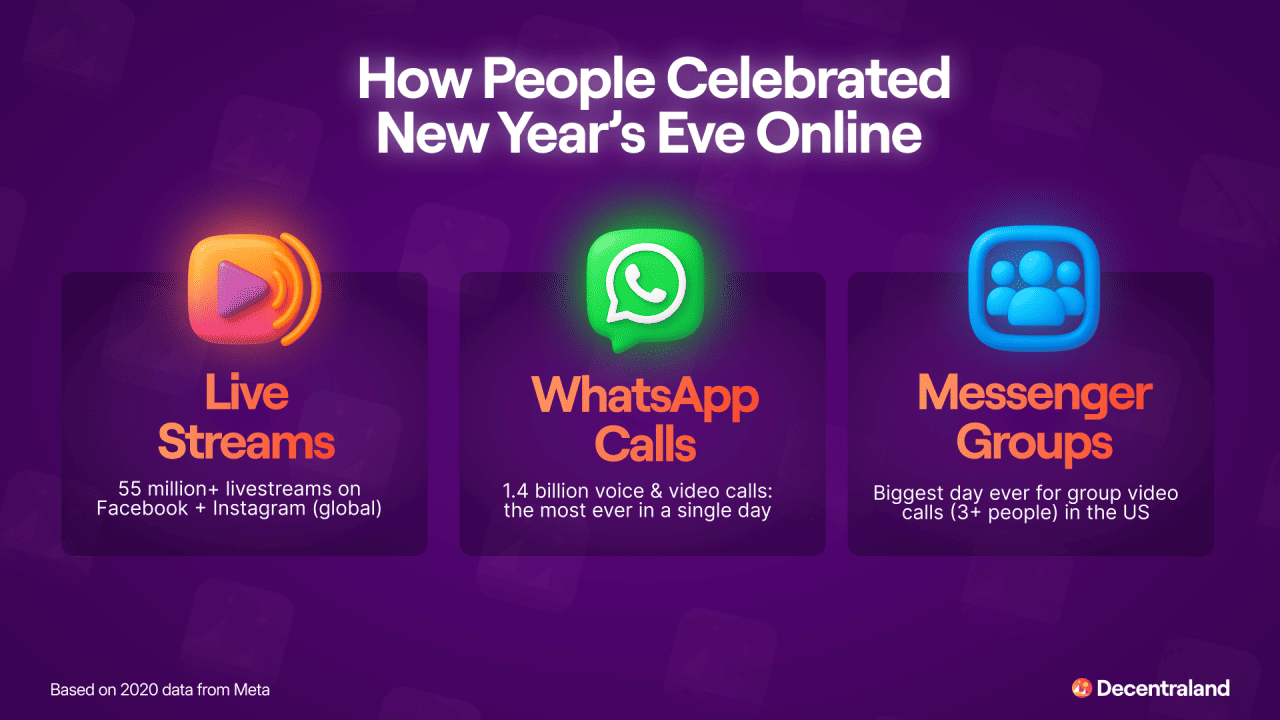
Livestreaming wasn’t new in 2020, but the pandemic pushed it into the centre of the holiday season in a way that hadn’t happened before. What was once a niche tool for gamers suddenly became a bridge for holiday traditions that couldn’t happen in person. Facebook reported more than 55 million live broadcasts across Facebook and Instagram globally on New Year’s Eve. It was a way to experience the holiday synchronously, even when people were physically apart.
Decentraland
Early to mid 2020s: TikTok, social games and virtual worlds
TikTok trends and shopping
By the late 2010s and into the early 2020s, TikTok became one of the strongest engines of holiday culture. The hashtag #christmas reached more than 21.6 billion views, according to NestScale, turning the platform into a kind of seasonal pulse point. Holiday rituals on TikTok aren’t fixed moments so much as ongoing microperformances: tree-decorating hacks, outfit reveals, comedic family skits, and countdown clips that surface rapidly on the ‘For You’ feed.
As the platform grew, it also became a major hub for holiday shopping. Recent data from Resourcera shows that 58% of TikTok users make purchases directly through the app, and November is consistently one of its highest-spending months with TikTok Shop generating over $1.29 billion that month in 2024, suggesting that people are browsing for buying gifts as well as holiday entertainment and inspiration.
Holidays in social games and virtual worlds
In the early 2020s, games got even more social. Players of Animal Crossing: New Horizons, for instance, used their in-game islands to recreate birthdays, weddings, and holiday gatherings reported GamesRadar. Seasonal events like Toy Day or Winterfest turned the game world into a festive venue where friends could visit each other and celebrate together.
These behaviors set the stage for more immersive synchronous experiences. Platforms such as Decentraland, Horizon Worlds and The Sandbox began hosting holiday concerts, themed trails, avatar fashion contests, and community-made festive builds. The simple seasonal moments from the 2000s had expanded into big immersive celebrations.

Decentraland
For example, Christmas in Decentraland 2019 comprised Festive Wearables, including an “8 Bit Christmas Sweater” and “Christmas Cyberpunk Eyewear,” wrote Decentraland Fandom. By 2021, players were teaming up for a multiplayer Santa-versus-Krampus snowball fight, which returned again in 2022. That same winter also saw the arrival of Bing Crosby’s Winter Wonderland, a build featuring mini-games, music moments, and a themed sweater shop. In 2023, the season looked more like a patchwork of online gatherings: Christmas Eve concerts, branded holiday giveaways, new venue openings, and small themed games built by different groups.
Today: Video calls, shared virtual spaces, and AI helpers
Video calls continue to be part of holiday rituals
With more families living across borders than ever—an estimated 304 million people reside outside their country of birth in 2024, according to the Migration Policy Institute, a research group focused on global migration data—staying close in December often depends on screens as much as travel. Even after the surge of pandemic use, surveys show that people continue to use video calls for family gatherings and celebrations across time zones.
Virtual worlds as shared spaces
As video calls became the default way to stay connected, virtual worlds now offer people a sense of place, letting friends and families meet, explore, and celebrate together in real time via holiday-themed activities such as interactive advent-style calendars.

Decentraland
Online workshops and shared creativity
Seasonal creativity also continues online. Platforms like Eventbrite still host virtual wreath-making classes, candle workshops, and holiday craft sessions: small, synchronous gatherings that bring people together despite physical distance. These workshops are the modern counterpart to community halls and kitchens, but with a broader reach and lower barriers to entry.
AI holiday cards and shopping
AI has slipped unsurprisingly into the holiday season. A 2024 piece in Bloomberg described how people were using AI tools to add “a little magic—but not too much” to their family cards, describing it as a “zero guilt” way to tidy up photos before sending them out. Tom’s Guide, a popular tech review and how-to site, echoed this sentiment more recently in a feature about making AI-generated cards through Nano Banana, showing how accessible these tools have become for anyone wanting something personal but easy.
AI-powered holiday shopping
AI is becoming woven into how people shop during the holidays. According to a Reuters report, shoppers used AI-powered chatbot services 42% more than the previous season, relying on conversational tools to find gifts, compare products, and navigate returns. Salesforce’s data shows that this shift played a meaningful role in influencing buying decisions throughout the 2024 holiday period.
When you look back on 30 years of celebrating holidays online, you can see that people have always used whatever tools they had available to stay connected when they couldn’t be in the same place. What started with message boards and e-cards grew into shared streams, group chats, and digital spaces where people gather in real time, but the intention didn’t change. As our lives stretch across cities and time zones, these shared digital spaces feel less like a novelty and more like a natural extension of how we already celebrate. They offer another way to show up for the people we care about when distance gets in the way.
This story was produced by Decentraland and reviewed and distributed by Stacker.

