
How artificial intelligence is changing the mental health space


What if your next therapy appointment involved opening an app instead of talking to another human? From chatbots that lend an ear at 2 a.m. to smart platforms that track emotional patterns over time, artificial intelligence is reshaping how people access and experience mental health care.
AI technology aims to help create machines that can do tasks that require human intelligence and problem-solving. You’ve likely already seen how AI has changed many industries, such as finance, retail, entertainment, and even healthcare. Researchers have also found ways to incorporate AI into mental health care, a field based largely on human connection and understanding.
Artificial intelligence therapy can’t replace human connection, but AI is beginning to play a real role in how people access mental health support. AI therapy can offer ways to support your emotional well-being, such as AI chatbots that can lend an ear and sophisticated tools that help mental health professionals personalize treatment plans. This article from Talkspace explores how AI therapy works, and if it can be an effective alternative to in-person or virtual therapy.
Quick Summary:
- AI therapy uses technologies like chatbots, natural language processing, machine learning, and predictive analytics to deliver mental health support or enhance human-led care.
- AI tools can help with mood tracking, skill-building, early symptom detection, and personalized treatment insights, but they can’t replace the empathy, nuance, or clinical judgment of a licensed therapist.
- AI therapy is best used as a supplement or starting point — not a standalone replacement for relationship-based mental healthcare.
What Is AI Therapy?
AI therapy uses AI technology to deliver mental health interventions through a digital platform. Some AI therapy tools let you interact directly with the AI. Other types of AI for therapy work behind the scenes to provide powerful analytics to support and enhance human-led therapy.
Common types of AI therapy tools include:
- Chatbots: An AI-powered chat that can have supportive conversations with real-time responses. When people use AI therapy chatbots like ChatGPT as therapists, these bots often try to use techniques from therapy to give you advice so you can manage depression, anxiety, loneliness, and more.
- Mental health apps with AI features: A mobile or web-based platform that uses AI to offer personalized therapeutic tools, like mood tracking and guided meditation
- Therapist-assisted tools: AI tools that can help support therapists by refining personalized treatment plans, predicting treatment outcomes, and analyzing patient data
- Predictive analytics: AI tools that can analyze someone’s mental state using biomarkers such as voice analytics, sleep patterns, or heart rate
AI Therapy Tools vs. Human Therapists
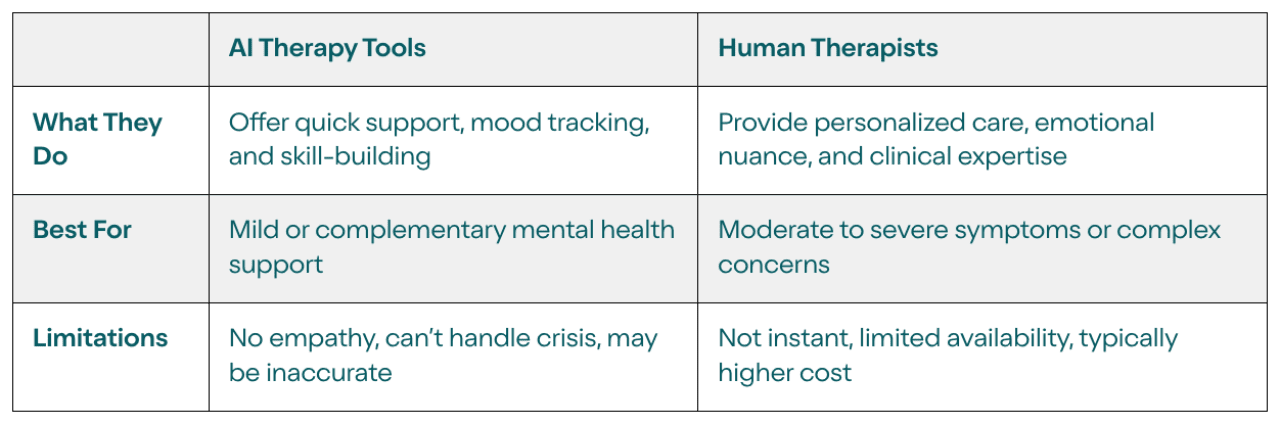
Because AI therapy can look different from traditional care, here’s a simple breakdown of how AI tools and human therapists each support mental health.
How Does AI Therapy Work?
Although AI may seem like a modern innovation, researchers have been asking, “Can you use AI for therapy?” for over 60 years. In 1966, researchers developed the first AI tool for mental health, called ELIZA — a chatbot designed to simulate human conversations for therapeutic applications.
The underlying technology that powers AI therapy has come a long way since ELIZA. Researchers train AI programs by designing special algorithms that tell the computer how to use and analyze data.
Below, explore some of the advances in AI technology that make modern AI therapy possible:
Natural language processing
Natural language processing (NLP) enables chatbots to simulate a natural conversation. NLP involves techniques that help AI understand, interpret, and generate human-sounding language.
You’ve likely interacted with AI programs using NLP. Apple’s Siri and Amazon’s Alexa use NLP to help understand requests and respond in a natural way. AI therapy uses NLP in a similar way to understand what you’re saying and respond in a conversational tone that doesn’t feel robotic.
Machine learning
Machine learning (ML) involves AI systems that can learn by themselves. ML allows AI systems to identify patterns and unique relationships. Chatbots commonly use both NLP and ML to understand what you’re saying and generate more personalized responses over time. That’s because ML helps chatbots learn about you the more you interact with them. This allows the chatbots to refine their responses and treatment suggestions over time.
Predictive analytics
Mental healthcare providers can use predictive analytics to help predict your risk and the likely outcome of a mental health condition. With predictive analytics, researchers can use historical data (information from your past) about you to predict future outcomes.
Predictive analytics AI programs use a number of different factors to help predict risk and outcomes, including:
- Your genetics: The genes inherited from your parents
- Physical traits: Characteristics like your weight, heart rate, and voice
- Environmental factors: Past trauma or social isolation
- Lifestyle choices: Diet, physical activity, and sleep patterns
- Social factors: Income, education, and support system
Some predictive analytics programs can help predict how you might respond to a certain treatment. This allows your mental healthcare provider to personalize the best treatment plan for you.
Sentiment analysis
Sentiment analysis is an AI tool that can help mental healthcare providers predict your mental status using NLP and ML. AI tools with sentiment analysis may be able to pick up on subtle clues from social media, journals, or chats that give insight into your mental state. For example, AI may be able to predict people at risk of depression or anxiety by looking for certain words or phrases.
A human therapist may use AI tools with sentiment analysis to detect subtle emotional cues in your voice or facial expressions during talk-based therapy. A shift in your voice’s pitch, tone, or rhythm can signal to your therapist that you may be experiencing anxiety or depression. AI analysis of your facial expressions may help therapists diagnose depression early.
Pros and Cons of AI Therapy
As AI therapy becomes more common and widely available, it’s natural to explore what it does and doesn’t do well. AI therapy is still in the early stages, but research has revealed some of the strengths and limitations to keep in mind.
Pros of AI therapy
One of the most persuasive arguments for using AI mental health tools in therapy is to ease the demand for accessible and affordable mental healthcare. Traditionally, therapy involves in-person or real-time video chats with a human therapist. However, there are often more people who need therapy than therapists, and one therapist can only talk to one person at a time. AI-powered therapy can interact with several different people at once. This makes AI therapy a potentially helpful first step or supplement to traditional therapy.
Some of the benefits of AI therapy that people seek out include:
- Accessibility: You can access an AI therapist chatbot 24/7 with no wait times.
- Affordability: It’s often free or offered at a lower cost compared to human therapy.
- Stigma reduction: AI therapy may be an easier entry point for those who are hesitant to see a therapist.
- Personalization: Many AI tools adapt over time, using your input and patterns to tailor responses, track your progress, and offer more relevant coping strategies.
“AI therapy tools can be a helpful first step for individuals who feel hesitant or overwhelmed about starting therapy, offering accessible, judgment-free support anytime,” says Talkspace therapist Cynthia Catchings, PhD, LCSW-S “They can also supplement traditional therapy by helping clients track moods, practice skills between sessions, and reinforce therapeutic progress.”
Cons of AI therapy
While there are many potential benefits of AI therapy, it’s also important to understand its limitations. Some drawbacks to AI therapy include:
- Lack of empathy: Chatbots can’t truly replicate a real human connection.
- Limited scope: AI tools aren’t designed to handle complex mental health problems, so AI therapy is often only helpful for people with mild to moderate symptoms.
- Crisis inadequacy: AI therapy isn’t safe or recommended for people in an active mental health crisis.
- Privacy concerns: The data collected by AI therapy systems is at risk of patient data breaches or misuse. There are no ethical guidelines to protect your data.
- Bias in algorithms: If AI therapy programs are trained on biased data, they may not produce the best or most appropriate responses.
- Inaccuracy: AI can sometimes hallucinate information, resulting in wrong or inappropriate advice.
“From a clinical standpoint, my biggest concern is that AI tools can lack the empathy, nuance, and cultural understanding needed to fully support someone in crisis or with complex trauma,” Catchings says. “While helpful in some areas, they should never replace the human connection that is often central to healing.”
Can You Use AI for Therapy Successfully?
“Yes, AI can support therapy by helping with self-awareness and skill-building, but it works best when paired with human connection and clinical guidance,” Catchings says.
Research shows AI can be effective in delivering mental health support, particularly for mild to moderate symptoms. A 2025 study published in NEJM AI found that users of an AI therapy chatbot, Therabot, experienced significant improvements in depression, anxiety, and disordered eating symptoms. However, results across studies remain mixed. While this research shows that AI chatbots can help temporarily reduce symptoms of depression and anxiety, other studies find little to no benefits for stress or overall well-being.
Either way, AI isn’t a replacement for licensed professionals. It lacks clinical judgment, crisis response capabilities, and the emotional nuance of human care. Used thoughtfully, though, AI therapy tools can offer accessible, scalable support, especially for those who might not otherwise seek help.
Human Support Still Matters: Where AI Meets Licensed Therapists
AI tools can change how we access and interact with therapy, but can AI replace therapists altogether? No, AI therapy isn’t meant to replace the care, empathy, and expertise of a licensed therapist. AI-powered digital tools can improve access to mental health care and may offer helpful support for mild or routine mental health concerns in between sessions. However, AI for therapy isn’t designed to fully replace trained professionals because they can’t understand nuanced human emotions and build a therapeutic relationship.
This story was produced by Talkspace and reviewed and distributed by Stacker.
