
69% of financial institutions have pulled the plug on an AI chatbot. The problem isn't always the AI.


The financial institutions many rely on are already using AI to handle some of their customer communications, and every message, from routine payment confirmations to fraud alerts, involves sensitive information. But how well AI handles these interactions doesn’t always depend on the AI itself.
New research from Sinch, which surveyed over 500 financial services leaders across 10 regions in January 2026, examines why nearly 7 in 10 organizations that have deployed AI in communications have had to pull it back at least once, and the impact on both sides of those interactions.
AI is already handling some of our most sensitive financial communications
Financial services is a complex environment in which to introduce AI. For consumers, every financial interaction carries a degree of caution, and for good reason. Financial fraud is an everyday reality for millions of people.
The Financial Trade Commission’s 2025 consumer protection data shows nearly $1 billion in reported losses to business impersonators, with bank impersonators accounting for the highest losses. Juniper even warned about a tidal wave of impersonation fraud in the coming years.
In this environment, trust is earned through decades of reliability, strict regulatory compliance, and accountability. It’s no surprise, then, that almost a third of finance leaders in the Sinch research cite compliance and legal concerns as the number one obstacle to AI deployment.
Despite this, 61% of financial services organizations have gone live with AI communications agents, and 52% say they’re very confident in their readiness to deploy at scale.
The industry is deploying AI through the complexity and with confidence, because the potential rewards are worth it. While customer support is a priority for 50% of financial institutions, the industry isn’t stopping there. It’s pushing AI into the highest-stakes communications, where customer trust and security are on the line. Fraud prevention is the second-most important AI goal at 43%, higher than any other industry. Identity verification follows closely behind at 33%.
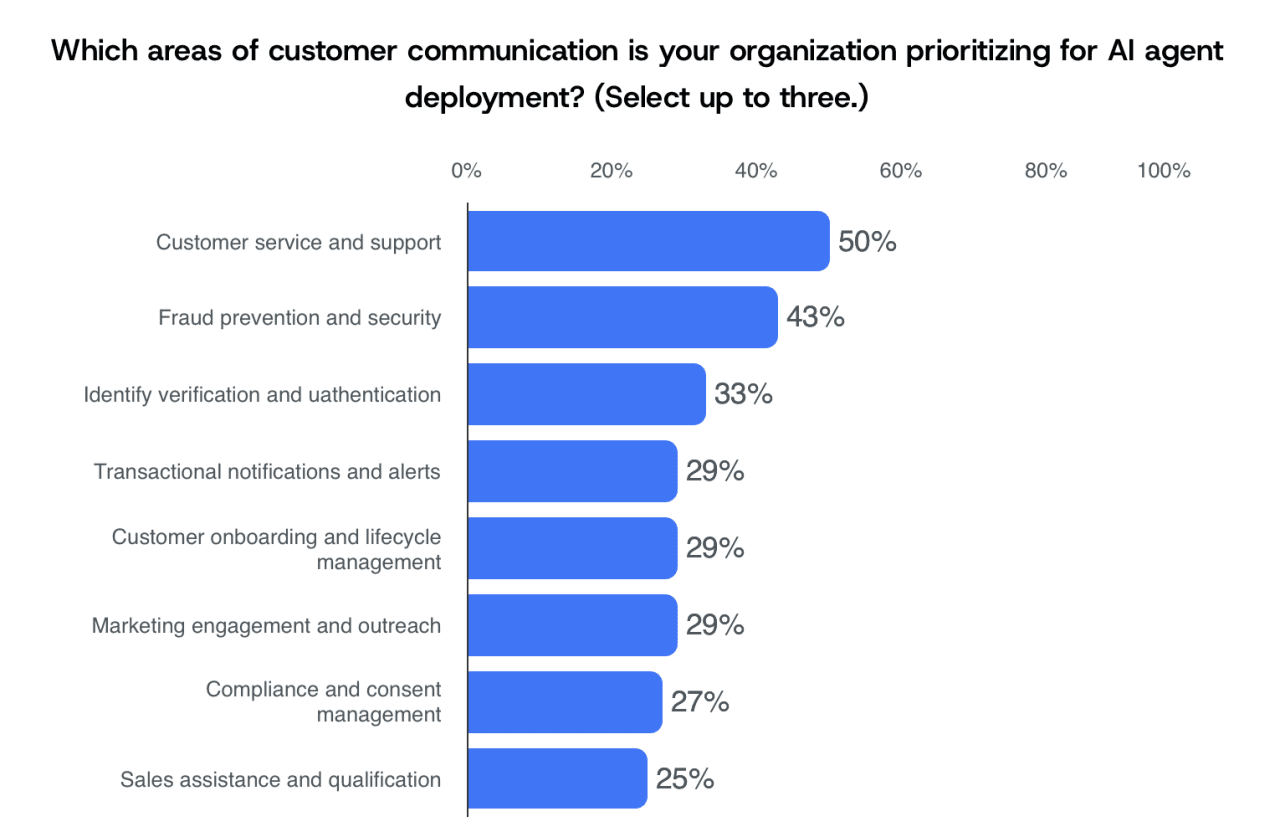
When a suspicious transaction gets flagged, an AI agent can reach the customer in seconds, confirm if it was them, and resolve it quickly before any permanent damage is done. In fact, in many cases, AI-based fraud prevention will even stop the fraud before it actually happens, blocking certain actions before they impact the customer.
Customer trust hinges on how well AI agents handle these situations and the customer interactions that follow, and research shows this hard-earned trust is being put to the test.
Even the most tightly controlled AI programs are rolling back
In financial services, the stakes are high for every AI communication. That’s no surprise, since every interaction touches on customers’ money, data, and the trust they’ve placed in the organization holding them.
Financial institutions have responded the way you’d expect from a heavily regulated industry: by investing in governance. And to some extent, the investment is paying off. Sinch research found that each step up in guardrail maturity makes financial organizations twice as likely to be operating at the most advanced deployment level.
So, contrary to what the market had assumed, compliance complexity and governance aren’t holding companies back from deploying AI agent. But they’re not preventing rollbacks either. Sinch research shows 69% of the industry’s AI agents have been pulled back due to a governance failure, just 5 points below the global rollback rate average. And that number is higher with the most governed organizations.
Lower rollback rates aren’t necessarily an indication of an organization’s AI success. They could very well be a sign of poor monitoring. But when 7 in 10 organizations that have deployed an AI agent have had to roll something back, that points to a deeper issue the industry still hasn’t been able to fix.
When money is at stake, every AI failure is a trust failure
When a financial services AI interaction fails, it puts consumers at risk and damages the relationship they’ve built with the company over years.
It’s an AI agent that doesn’t send the fraud alert it was specifically deployed to trigger. Or one that surfaces account details to the wrong person, or that confidently states the wrong balance or mortgage rate. Customer data exposure and hallucinations are the two leading causes of AI agent rollbacks, at respectively 27% and 21%.
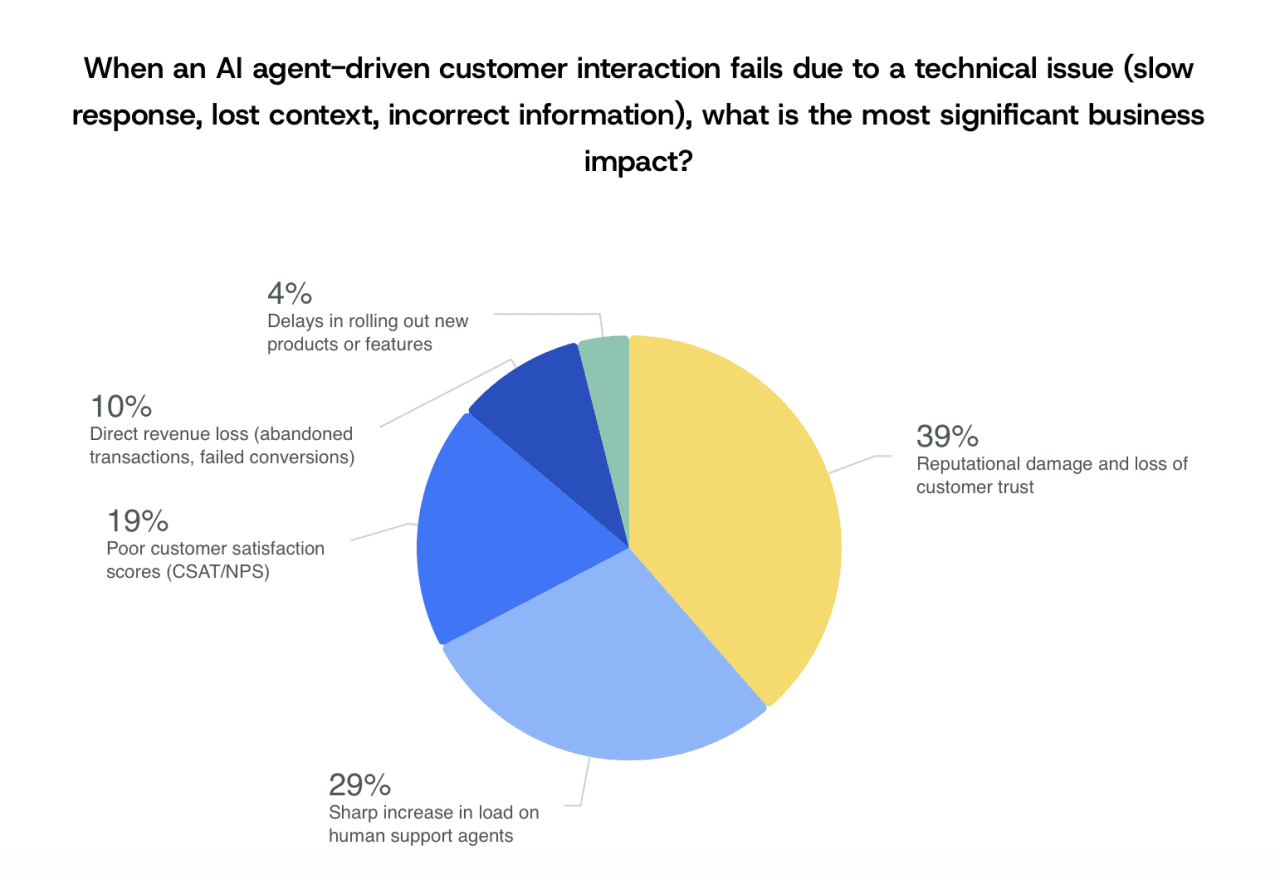
For a financial institution, these failures are compliance and trust failures at the same time. That’s why, for financial leaders, the most significant business impact of AI agent failures is reputational damage, ahead of operational strain — the top concern globally. That’s also the one consequence that cannot be fixed.
Attention is turning to what’s underneath the AI
Financial services are investing heavily in their most important asset: customer trust.
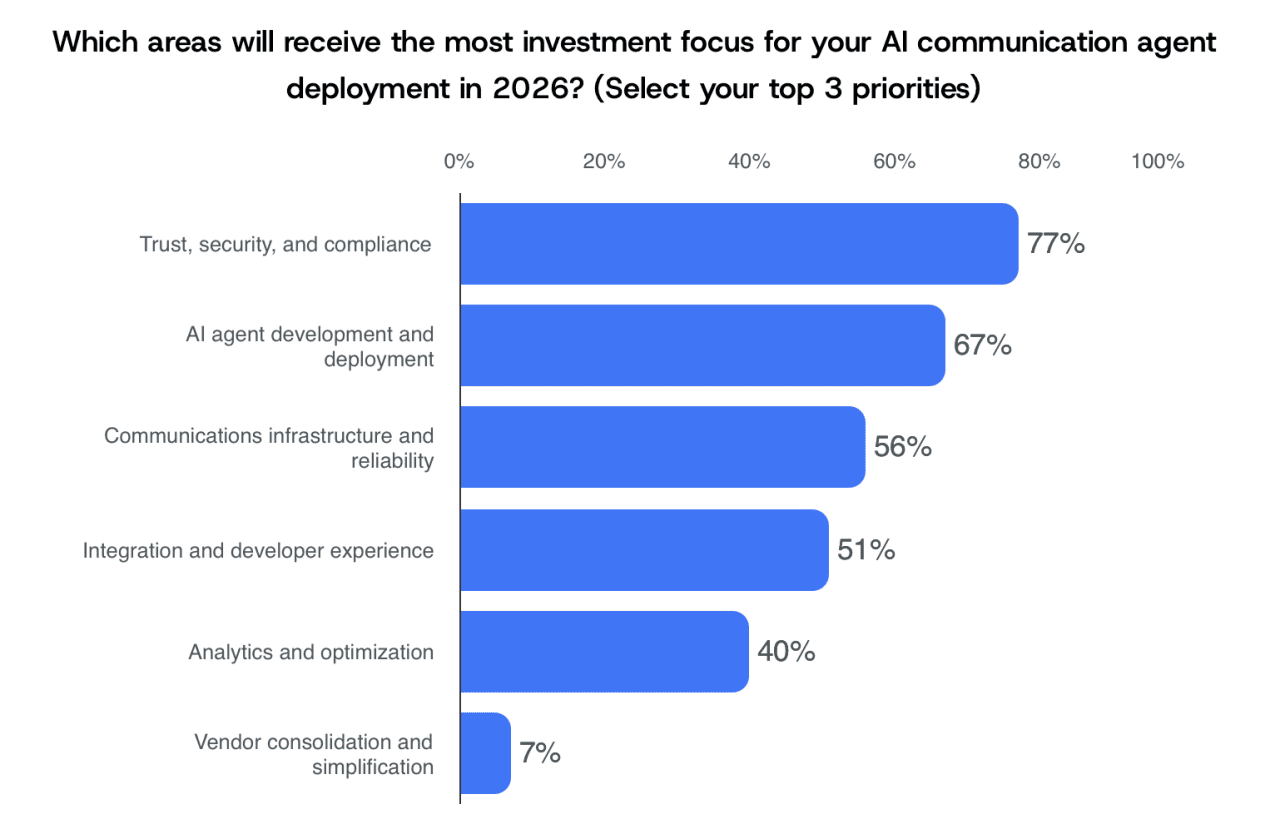
In fact, trust, security, and compliance is the #1 spending category in the industry at 78%, well ahead of AI agent development (67%). But that spending isn’t closing the gap between deploying an agent and keeping it live.
That’s because oftentimes, the problem isn’t the AI agent itself. It’s the infrastructure it’s built on. Sinch research found that communications infrastructure satisfaction is the strongest predictor of AI deployment success — stronger than AI investment level, maturity, or governance sophistication.
Yet, findings suggest that infrastructure investment still has room to grow in the industry. While 83% of financial institutions agree that high-performing infrastructure is essential or very important to deploying AI safely, only 56% actually prioritize it when investing — 5 points below the 61% average.
Despite infrastructure investment lagging slightly in financial services, the industry has started evaluating new providers. 83% of financial institutions in the study are already having active or exploratory conversations with alternative providers. Organizations citing a lack of AI integrations are 2.4 times more likely to evaluate a new provider, and those citing poor reliability are 1.4 times more likely.
Trust in AI communications is built from the foundation up
In financial services, the difference between an AI agent that serves and protects consumers and one that fails them goes beyond governance. It also comes down to the infrastructure underneath it. When that foundation holds, so does the trust they’ve placed in the institution holding their most sensitive assets.
This story was produced by Sinch and reviewed and distributed by Stacker.
