
Doomscrolling (and kids) destroyed my reading habit. Could the ‘Booker Challenge’ save it?

By Oscar Holland, CNN
Novels are an endangered art form. In the early 1990s, more than 60% of American adults finished at least one book a year; today, fewer than half do. Gen Z often takes the heat for this decline, but we’re all to blame — including me, a time-poor millennial with two young kids, two phones and a roughly-two-minute attention span.
Each January, for the last few years, I have set myself a (what I thought to be) perfectly achievable New Year’s resolution: to read, for the sake of pleasure alone, 12 books in 12 months. And each fall, for the last few years, I found myself behind schedule and shamelessly attempting to game my own challenge. What if I blasted through some poetry to make up the numbers? And plays counts, right? They’re technically books but are short enough, almost by definition, to finish in one sitting.
Just like that, the joy of reading I’d hoped to rekindle was lost. Instead of offering an escape, literature had become a source of angst. In our over-optimized age, where “microlearning” apps promise to condense books into bullet points that can be injected, via AirPods, into our saturated minds, picking up a novel felt like a lapse of productivity — or a guilty pleasure to contemplate before spending an hour mindlessly doomscrolling.
As a journalist, I consume plenty of non-fiction (though I often skim-read for efficiency’s sake). I also read a staggering number of children’s books. In my own time, however, I still feel an unrelenting pressure for books to serve professional interests or make me — or, at least, make me feel — smarter.
What I needed was a strict deadline, an expectant editor and an excuse to read make-believe professionally. Enter my entirely self-directed “Booker Challenge.”
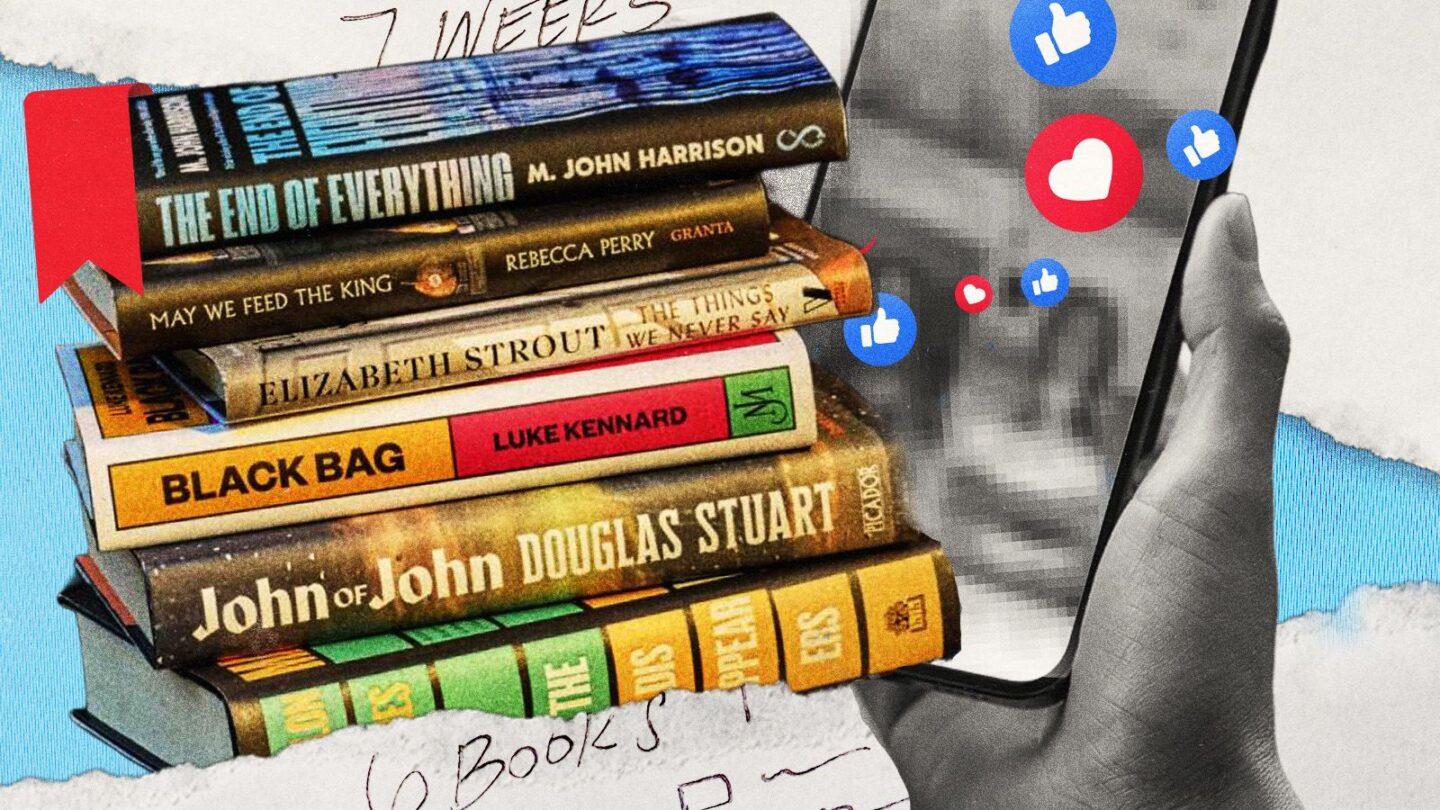
On September 22, the Booker Prize unveiled its annual shortlist. These are, in theory, the year’s six best novels. Although originally for British, Irish and Commonwealth writers, the prize is now open to all English-language books and considered the most prestigious accolade for a single work of fiction. For this year’s longlist, the jury got through over 160 books in six months. One judge, historian Mary Beard, has said that this meant working “harder than I have ever done before.” But surely reading the six-book shortlist, in the seven weeks before the winner’s announcement, wouldn’t be that difficult?
Their combined 2,000-plus pages, I calculated, amounted to a very manageable 45 pages a day. Reading app Swiftread told me this would take the average reader just 1.3 hours. My iPhone’s nagging Screen Time notifications, meanwhile, told me that I spend longer — much longer — than that staring at my devices each day. It may feel like I have no free time, but it turns out I, objectively, do.
I could complete my challenge and still have a few hours left to doomscroll.
Escapism of yore
My anxiety around reading has snowballed since becoming a dad in 2024. But while my kids are obviously significant (and welcome!) consumers of my diminished downtime, I cannot blame parenthood for my failures. In truth, my once-healthy reading habit has been under assault since 2011. The inaugural culprit: my very first iPhone.
As a teen in the pre-smartphone era, I would devour fiction, both classic and contemporary, wherever I could. Traveling to school by train — and with no way to check my Myspace for the latest updates — I would frequently lose myself in fictional worlds, there and back. Now, my commute involves the routine carousel of Instagram, Reddit, news, Slack, soccer results, already-read WhatsApp messages and then back to Instagram again.
In the past 15 years, I have normalized mild repetitive strain injuries to my right thumb, and that shameful feeling of mechanically reopening an app that I’d only just closed because my brain has short-circuited the order in which I’m supposed to deliver it dopamine microdoses. I have normalized the déjà vu of scrolling past the same content twice because I didn’t give the algorithm enough time to refresh.
This year’s Booker Prize shortlist offered a tantalizing return to the escapism of yore. Its six books promised to take me from a medieval royal court to a post-alien-invasion-near-future, via 1980s Jamaica, 1990s Scotland, 2020s Massachusetts and present-day London. For the first time in a long time, I felt excited to read.
I began with the prize’s two favorites, both written by former winners. Leading the pack, Marlon James’ “The Disappearers” charts the devastating fallout of a homophobic attack on a theater rehearsal in Kingston, Jamaica that leaves one dead, one maimed and, soon after, two missing. Masterfully told through letters, journals, interview transcripts and monologues, the monumental 600-page story placed me deep in the psyches of men grappling with the unceasing threat of violence.
The bookmaker’s second-favorite, Douglas Stuart’s “John of John,” is similarly engrossing — albeit in an entirely different way. This time, I was transported to the remote Scottish island of Harris, where an arts graduate returns home to his strict, pious father and the repressive (and repressed) Presbyterian nest he thought he had flown. It is quietly gripping and beautifully written.
Both books would be worthy winners. They are also the two longest. But, invigorated by my challenge, I felt a warm nostalgia carrying the heavy tomes under my arm everywhere I went.
Hoping to forge new routines, I snuck in chapters at my son’s swimming class, the doctor’s waiting room, and the office during lunch. I smugly enjoyed being the only person on the bus not staring at a screen. At home, where my infant daughter decided she would only nap in my arms, I found that a large paperback book fit perfectly on top of her tiny torso. When she was asleep in her crib, I read under my bedcovers with a nightlight.
Old habits die hard
For the first three weeks, I hit my 45-page average with ease. Overperforming on weekends helped offset busier midweeks. Then, my first major obstacle: a 0-page day. Forgive me: It was my birthday and I was hungover. I didn’t want to read. My mind immediately began its familiar mental gymnastics. Do I need 90 pages tomorrow to catch up? Or do I just read a couple extra a day, from now on, to compensate? Is this suddenly becoming less fun?
Upping my daily target to 47 pages, the challenge continued apace. On vacation, I read American author Elizabeth Strout’s “The Things We Never Say,” the tender tale of an affable middle-aged schoolteacher with suicidal thoughts, an urge to shoplift and a burdensome family secret. I then power through M. John Harrison’s wonderfully inscrutable “The End of Everything,” which imagines a partially collapsed society following an invasion by mysterious beings whose activities and intentions are beyond human understanding (AI, anyone?).
Next up is debut novelist Rebecca Perry’s impressive “May We Feed the King,” a dual narrative that flits between a museum curator and a medieval monarch — reluctantly and unexpectedly thrust onto the throne following the death of his older brothers — whom she is researching.
I enjoyed them all, for unique and varied reasons. And yet, old habits die hard. Sometimes, I found myself hiding my phone inside my book, so my wife didn’t realize when I had erred. Some days, I looked forward to after-dinner reading, but others I just wanted an early night or to vegetate by way of streaming.
As the challenge trundled on, the harder it became. I began experiencing a sense of relief when a chapter’s final page was revealed to be mostly white space, or when a new section started afresh on the next spread. This was no reflection of the books’ quality. In fact, the final nominee I read, “Black Bag” by Luke Kennard, was among my favorites — a gloriously surreal but relatable story of an out-of-work actor hired to attend college while zipped in a leather bag for a psychological experiment.
The problem was becoming clear: In our over-optimized age, I had just created another metric to agonize over.
‘Attention rehabilitation’
The reading slowdown is a global phenomenon. In Singapore, where I am writing this from, a government campaign against “brainrot” is paying people to read for 15 minutes a day. As a non-citizen, I am ineligible for the cash (which only amounts to about 80 US cents for 50 consecutive days), but I joined a series of accompanying talks hosted by the country’s National Library Board.
In one, Richard Cytowic, a neurologist who only checks his email twice a day, warned that humans can’t really multitask — we just rapidly move between tasks, with each switch costing us time, attention and energy. Interruptions leave us with what he called “attention residue,” because returning to complicated matters means having to reconstruct the mental context we built before the interruption. “Deep reading,” he said, “asks the brain to do what endless scrolling prevents: Remain with one thing long enough for meaning to accumulate.”
Reading also puts the “tempo of attention” back in our hands, argued Cytowic, who authored the book “Your Stone Age Brain in the Screen Age.” “We may pause, reread, wonder or allow an image to develop — nothing advances automatically,” he said, adding: “Reading is far more than an escape from distraction. It is rehabilitation for an attention system that has presently been trained to expect one interruption after another.”
He is less enthusiastic, however, about target-based approaches. Has my Booker Challenge, to use his words, turned “rest into another performance, a step count, a meditation streak, a podcast consumed at the double speed”? Should I, in his words again, learn to “tolerate a few minutes that cannot be measured, optimized or displayed as an achievement”?
Probably. I have been a journalist long enough to know that I respond best to deadlines. I feel I have achieved plenty of “deep reading,” and I am struck with genuine satisfaction whenever I see the completed tomes stacked on my bedside table. But this challenge has come at a cost. Other parts of my life have, indubitably, suffered.
Over the last seven weeks, I have slept far less than is recommended by medical professionals. I am woefully underprepared for the half-marathon I signed up for. My midweek social life has shriveled, from negligible to non-existent. A growing pile of untouched magazines and weekend newspapers (yes, actual paper ones) stands testament to everything I didn’t read.
And while I was confident that I hadn’t neglected my parental duties, I noted my wife’s subtly barbed response when — using my Booker challenge as evidence — I reassured a friend over dinner that the arrival of his second child didn’t have to spell the end of his free time. “I’m happy for you,” she said from the other end of the table, not quite rolling her eyes.
Like most things in life, the key to being a better reader is likely small, regular doses, rather than sudden intense bursts pegged to major news events. Perhaps, next time, I will give myself the whole year to read the shortlist. Perhaps I’ll join a book club or BookTok, or enlist friends to join me on the journey. Or perhaps I’ll just follow Singapore’s 15-minutes-a-day approach, even if I can’t collect my 80 cents.
The-CNN-Wire
™ & © 2026 Cable News Network, Inc., a Warner Bros. Discovery Company. All rights reserved.