
Could the ‘blue tsunami’ jolt the US job market back to life?

By Alicia Wallace, CNN
(CNN) — The US labor market has been amazingly resilient in the face of a barrage of economic shocks.
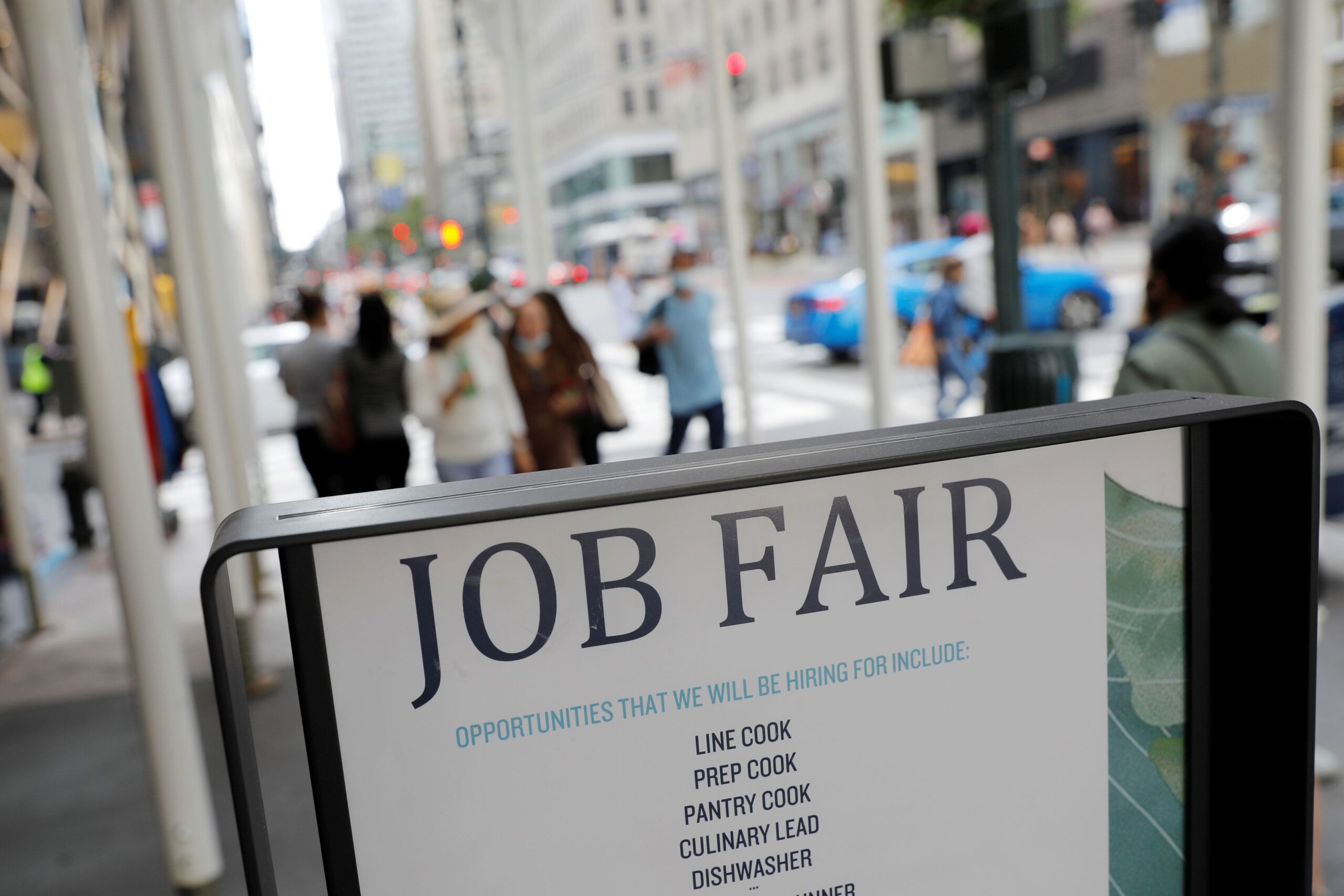
The unemployment rate has been at or under 4.5% for a record-setting five years and Friday’s stronger-than-expected jobs report for October showed that employers are hiring at one of the fastest clips in the past three years.
But the monthly snapshot also revealed some troubling trends: Americans’ average stint on unemployment is the longest it’s been in nearly five years; the bulk of the job gains remain relatively concentrated to few industries; and workers’ wages continue to fall further behind inflation.
So, while the labor market may be stable, it has not been running on all cylinders: Its gears have been gummed up for quite some time.
Economists have questioned how long the stasis could last, and what could cause it to break in one direction or the other.
The “blue tsunami” has now entered the chat.
What that means for the labor market’s trajectory remains to be seen – it’s still very early innings, and there are plenty of weightier factors already at play. But here are some of the areas economists are watching closely amid a reshaping of the political landscape:
Nothing is changing overnight
First things first, change takes time and policies have limitations.
“Elections can shift the policy outlook, but they rarely change the labor market overnight,” said Cory Stahle, senior economist at online job marketplace Indeed. “The forces shaping hiring right now, from an aging workforce to AI adoption, were in place before the election and will still be there next year.”
The labor market is undergoing some structural shifts. The labor force is shrinking because of an aging population, increased retirements from Baby Boomers, and a reduction in net immigration. Technological innovations, notably artificial intelligence, are transforming jobs, industries and the economy.
To address the concerns of businesses wrestling with labor supply constraints, policies can be implemented to increase immigration or encourage more people to have children, but the effects of those don’t happen overnight, he said.
If Americans are wanting to see quicker changes that impact their personal economies, that’s much more likely to come at the state level than at the national level, said Tyler Schipper, associate professor of economics at St. Thomas University in St. Paul, Minnesota.
At the national level, Congress can only do so much by itself, and President Donald Trump still has veto power, Schipper said.
At the state level, there’s more that can be done, he said, to address affordability concerns for businesses and the consumers that power the economy.
But even those take time.
“For instance, states can do a lot of work on transportation networks, and they can do a lot to make housing more affordable; but those are both investments that don’t see quick returns, even if they are investments that start right away in January,” he said.
Silver lining of gridlock
A divided federal government comes with some risks.
“What we might see at the national level is more gridlock and a lot of budget negotiations that have the potential to lead to government shutdowns,” Schipper said. “So, I am not entirely sure that people get the quick wins maybe they were hoping for at the national level.”
Gridlock also suggests that major policy changes may be limited.
And that, in a way, could provide a dash of much-needed certainty.
“One of the drags on hiring has been uncertainty – uncertainty around tariffs, uncertainty around energy prices,” said Gus Faucher, chief economist at PNC Financial Services. “We might see lower levels of uncertainty, and overall, that’s good news for the labor market.”
Tariffs and war
Sweeping tariffs on imports have been a signature economic policy for Trump, who has stated a desire to bolster America’s manufacturing industry and generate federal revenue.
Manufacturing employment is showing some signs of life after a post-pandemic bout of job-shedding, including the loss of 113,000 jobs last year: Through October, the industry, which employs 12.7 million people, has added 101,000 jobs and has seen net gains for five months in a row.
However, those higher import costs were passed through supply chains and consumers, adding upward pressure to inflation last year. As those effects started to fade early this year, the US and Israel’s strikes on Iran set off a monthslong war that caused an energy shock that sent gas prices – and inflation – higher, further compounding Americans’ yearslong affordability concerns.
Goldman Sachs economists, in a note earlier this week, said they expect Democrats to use fiscal deadlines to seek limiting the war with Iran, roll back selected tariffs and reverse spending cuts enacted last year.
It’s possible there could be enough bipartisan support in Congress to convince Trump to stop a trade war with a particular country, such as Canada, Schipper said. As for the Iran conflict, a War Powers Resolution might not be veto-proof.
“Even if congressional pressure can help wrap up the war, a lot of the lingering effects that people are feeling, those don’t immediately go away,” he said. “The damage has been done, and that’s going to take quite a bit of time to resolve, even once the conflict has some kind of durable end.”
Looming healthcare cuts
The healthcare and social assistance sector, buoyed by some of the demographic shifts that are shrinking the labor force, has been responsible for the lion’s share of employment gains in recent years.
That industry faces significant risks as a result of major cuts on Medicaid eligibility and funding set to take effect on January 1, 2027, said Diane Swonk, chief economist at KPMG.
“We don’t know what’s going to happen if [Congress] gets a reconciliation package in the lame duck session or not,” Swonk said. “If they don’t, this is something that Democrats are going to want to try to get through themselves.”
The cuts would create a big hole to fill for the state and local governments that administer the programs, she said. It could result in fewer programs and clinics as well as increased consolidation, negatively impacting jobs and services, she said.
“It’s really hard on rural areas but also in lower-income areas as well,” she said.
The AI elephant in the room
While AI has the potential to reshape the economy and millions of jobs, the technology also has been met with much concern and fear from Americans – especially as it relates to their jobs and household finances. AI adoption has been a frequent reason cited in companies’ layoff plans in recent months, Challenger, Gray & Christmas data shows; however, those tend to overstate what’s actually happening in the labor market, PNC’s Faucher said.
“AI, at least as of yet, has not been transformative for the labor market,” he said.
Stricter regulations around AI and data centers aren’t likely to immediately occur at the federal level, according to the Goldman Sachs projections.
The same can’t be said for the state level, their economists noted.
“The states where Democrats are likely to further restrict data centers account for roughly 45% of planned US data center capacity, with Texas alone accounting for roughly 25%,” they wrote. “However, since data centers are low on the list of priorities for voters this election, we expect that the issue will fade somewhat in importance in the ensuing months and that these moratoria will not be long-lived if they are enacted.”
Tuesday’s election results provide a check on AI companies and allow communities to have a greater say in who does and doesn’t want them, Schipper said.
“It means that communities that might be more economically distressed have a better chance of winning some of those data AI center contracts, where it could actually have meaningful impacts in those communities,” he said.
It’s possible that a slowing of AI-related developments could ease concerns that the rapid boom in investment would be followed by a bust, said Joe Brusuelas, chief economist at RSM US. The slowing in AI-related spending also could also open up more non-tech investment, he said.
“The boom in AI was crowding out both public and private-sector investment,” Brusuelas added. “The idea there’s going to be a slowing means there will be a redirection of capital into the real economy to meet legitimate needs of non-tech areas.”
Still, as the markets’ volatility showed Thursday, risks remain that a prolonged correction in AI stocks could have big negative wealth effects that bleed into the larger economy. US consumer spending has been robust in part because of the wealth effects created by the strong stock market.
Great expectations
There are understated expectation effects from the midterm results, Schipper said.
If people can properly set their expectations about how much a Democratic Congress can do on its own, those expectations could ultimately have an effect on the broader economy, he added.
Consumer sentiment has been circling the drain for much of this year as a war-driven spike in gas prices and concerns about AI’s potential negative effects on the labor market have further compounded affordability concerns.
“One of the things that’s been holding the economy back, not sending into a recession, but maybe holding it back, has been that people are generally pessimistic about both their current circumstances and the future,” he said. “People might feel slightly more positive if they see more of their politicians working for them, even if it’s not necessarily getting results.”
The-CNN-Wire
™ & © 2026 Cable News Network, Inc., a Warner Bros. Discovery Company. All rights reserved.