The chronic conditions most commonly addressed in AI healthcare visits


Krakenimages.com // Shutterstock
Thyroid disorders, diabetes, and high cholesterol dominate AI healthcare visits, reflecting a shift in how Americans manage long-term health.
When patients visit an AI healthcare provider, they’re not typically seeking a diagnosis for mysterious symptoms or treatment for acute emergencies. They’re managing conditions they’ve lived with for years.
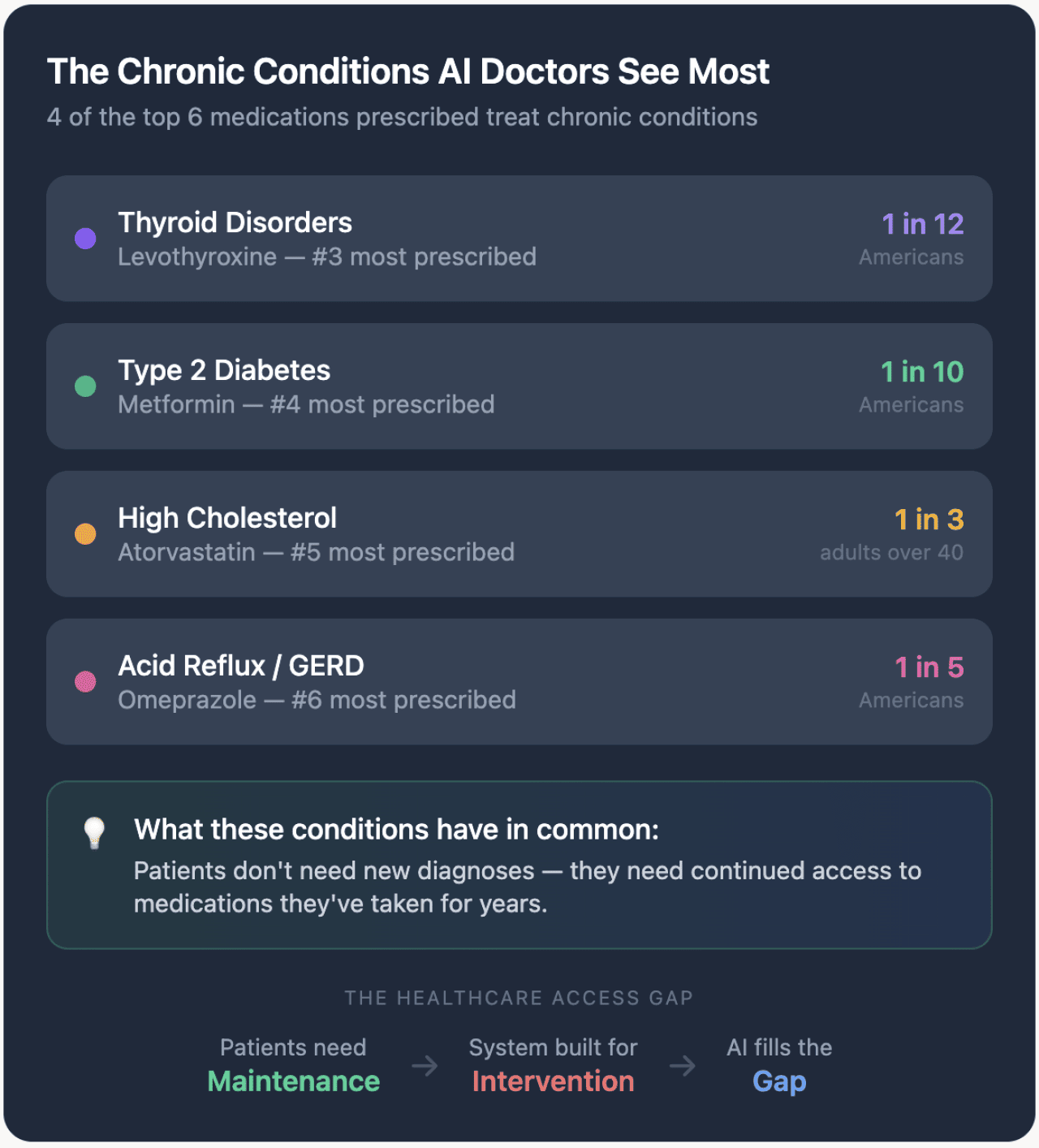
Prescription data from Doctronic, an AI telehealth platform, reveals that chronic disease management dominates AI healthcare visits. Medications for thyroid disorders, Type 2 diabetes, and high cholesterol rank among the top five most prescribed, trailing only common pain relievers.
Levothyroxine, the standard treatment for hypothyroidism, ranks as the third most prescribed medication on the platform. Metformin, the first-line treatment for Type 2 diabetes, comes in fourth. Atorvastatin, a widely used cholesterol-lowering statin, rounds out the top five.
The pattern suggests AI healthcare could be a front door for chronic disease management — conditions that require ongoing medication access rather than complex diagnostic workups. For patients living with these conditions, the appeal is straightforward: continued access to medications they’ve taken for years, without the friction of scheduling appointments weeks in advance for visits that may last only minutes.
The Chronic Disease Burden
The medications appearing at the top of the list reflect the conditions affecting the largest share of the American population — and the ones placing the greatest strain on the healthcare system.
An estimated 20 million Americans have some form of thyroid disease, according to the American Thyroid Association, with hypothyroidism being the most common. Up to 60% of those with thyroid disease are unaware of their condition, making it one of the most underdiagnosed conditions in the country. For those who have been diagnosed, treatment typically means daily levothyroxine for the rest of their lives.
Once a patient’s thyroid levels stabilize — often within the first year of treatment — many go years without needing changes to their medication. The dosage stays the same, the routine stays the same, and the only variable is maintaining prescription access. Yet many refills require a provider visit, taking up appointment slots and physician time for what amounts to a brief confirmation that nothing has changed.
Type 2 diabetes tells a similar story at an even larger scale. The condition affects roughly 38 million Americans, with the CDC noting that 90% to 95% of all diabetes cases are Type 2. Metformin has been the first-line treatment for decades, and for patients whose blood sugar is well-controlled, ongoing care often consists of routine refills punctuated by periodic lab work and annual check-ins.
The math is striking: Millions of Americans need ongoing access to the same medications, year after year, to manage conditions that — when properly controlled — don’t require frequent clinical intervention. Yet the traditional healthcare system treats each refill as a discrete event requiring physician involvement.
High cholesterol follows the same pattern. Statins like atorvastatin are among the most prescribed medications in the country, typically taken at the same dosage for years or even decades. The ongoing need for prescription renewals can mean repeated appointments for patients whose treatment plans haven’t changed since their initial diagnosis.
Doctronic
Why Chronic Conditions Suit AI Healthcare
The nature of chronic disease management aligns well with what AI health platforms are designed to do — and exposes where traditional healthcare struggles.
These conditions share common characteristics: established diagnoses, stable treatment protocols, and predictable medication needs. A patient who has taken metformin for five years doesn’t need a new diagnostic evaluation each time they need a refill. They need continued access to a medication that’s already working.
Traditional primary care often struggles with this reality. Physicians face appointment backlogs that have grown steadily worse over the past two decades. The average wait time for a new patient appointment is now 26 days, according to survey data — and that’s in major metropolitan areas with relatively high physician density. In rural areas and underserved communities, waits can stretch considerably longer.
Meanwhile, routine refill visits compete for the same limited appointment slots as patients with acute concerns, complex cases, or genuine diagnostic needs. The result is friction on both sides. Patients wait weeks for brief appointments, face gaps in medication access when schedules don’t align, and pay for visits that deliver little clinical value. Physicians spend time on routine renewals instead of cases requiring their full attention, contributing to the burnout that has become endemic in primary care.
AI telehealth providers can absorb much of this routine workload. By handling stable refills for chronic conditions, they free up physician time for patients who need diagnostic judgment, treatment adjustments, or complex care coordination — the work that requires human expertise and clinical intuition.
The Omeprazole Signal
Beyond the top five, other medications in the data reinforce the chronic condition pattern. Omeprazole, a proton pump inhibitor used for acid reflux and GERD, also ranks among the most prescribed medications on the platform.
The National Institute of Diabetes and Digestive and Kidney Diseases estimates that about 20% of people in the United States have GERD — a condition often linked to diet, stress, obesity, and lifestyle factors that have become endemic in modern American life. Unlike acute conditions that resolve with treatment, GERD is typically a chronic condition requiring ongoing management.
Like thyroid, diabetes, and cholesterol medications, omeprazole is usually prescribed for long-term use rather than short-term treatment. Patients may take it daily for years to manage symptoms, requiring regular prescription access without necessarily needing frequent provider evaluation. The condition is stable, the treatment is established, and the primary need is continuity rather than intervention.
The consistency across medication categories suggests patients are finding AI healthcare useful for maintenance — the ongoing, unglamorous work of keeping chronic conditions controlled. These aren’t patients seeking dramatic interventions or complex diagnoses. They’re patients trying to maintain the health they already have.
What This Means for Healthcare Delivery
If a significant portion of primary care visits involve stable chronic condition refills, that represents physician time that could potentially be redirected toward more complex care. It also represents a substantial cost burden on patients, who pay for visits that deliver little beyond prescription renewal, and on the healthcare system as a whole.
This doesn’t mean chronic conditions are simple or unimportant. Diabetes, thyroid disorders, and cardiovascular disease require careful management and can have serious consequences if neglected. Patients need regular monitoring, periodic lab work, and access to physician expertise when their conditions change or complications arise.
But for patients whose conditions are well-controlled — the majority of those taking these medications — the question becomes whether every touchpoint needs to involve a physician, or whether some of that access can be maintained through other channels without sacrificing quality or safety.
The Association of American Medical Colleges projects that the United States could face a physician shortage of up to 86,000 physicians by 2036, with primary care facing some of the steepest gaps. Population growth and aging are driving increased demand for healthcare services at the same time that physician supply struggles to keep pace. By 2036, the population aged 65 and older is projected to grow by 34% — the demographic most likely to be managing multiple chronic conditions.
For millions of Americans managing chronic conditions, the goal isn’t finding a diagnosis — it’s maintaining the treatment that’s already working. AI healthcare could help meet that need.
This story was produced by Doctronic and reviewed and distributed by Stacker.


