
Surprise twist ricochets through Supreme Court case on AR-15 ban

By John Fritze, CNN
(CNN) — A blockbuster Supreme Court appeal challenging a ban on AR-15-style semi-automatic rifles may be thrown into disarray by a mysterious request to remove the lead plaintiff from the case, a puzzling twist that prompted the ban’s defenders to ask the justices on Thursday to dismiss the case.
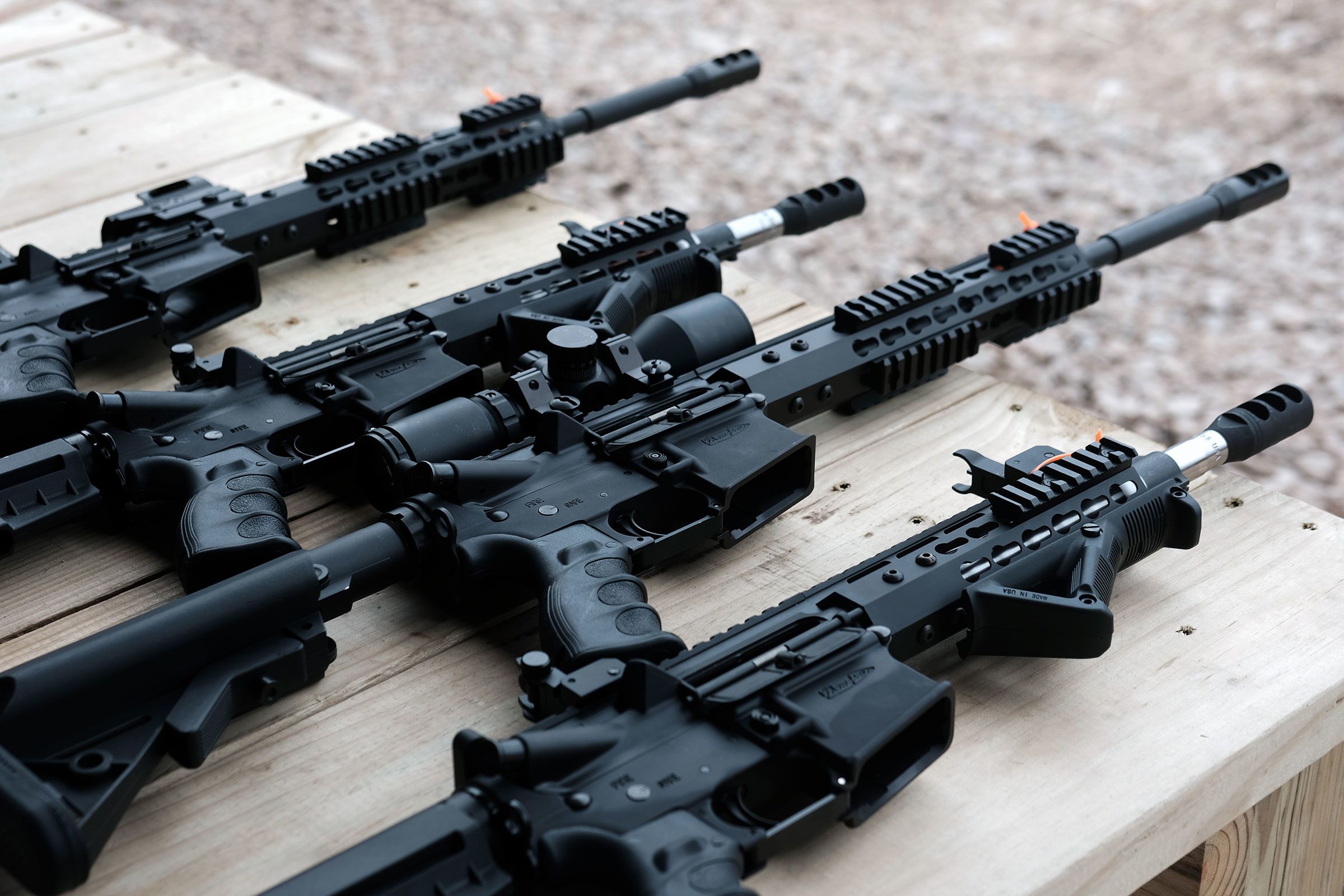
The case, which the Supreme Court has scheduled for argument next month, centers on a Cook County, Illinois, ordinance that makes it unlawful to sell or possess any “assault weapon or large capacity magazine,” including AR-15 rifles.
Two Illinois men claimed the ban violates the Second Amendment. But in a one-paragraph filing last week, attorneys for the lead plaintiff, Cutberto Viramontes, asked to be removed from the litigation without explanation.
Thursday, Cook County said that if Viramontes is removed, it would make the case moot — meaning that the justices would throw it out.
“Viramontes has not offered any explanation as to why he sought to remove himself from the suit,” the Cook County State’s Attorney, Eileen O’Neill Burke, a Democrat, told the Supreme Court in the filing. “And the most natural inference from the barebones motion is that Viramontes’ circumstances have changed in some significant fashion.”
Viramontes’ attorneys at the Cooper & Kirk law firm have not responded to CNN’s repeated requests for information about why he wants to leave the case.
On one level, whether Viramontes is permitted to withdraw would have limited practical significance for the broad question of whether state and local governments may ban AR-15-style rifles.
The Supreme Court simultaneously granted a second case in June, challenging Connecticut’s similar ban, which would continue even if the Supreme Court decided to dismiss the Cook County litigation. And whatever the court decides on Connecticut’s ban would almost certainly affect whether other bans like the one in Cook County can stand.
On the other hand, Viramontes’ unexplained departure raises questions about the vetting law firms conduct when they file suits on behalf of plaintiffs that, from the start, are intended to move the law by setting a nationwide precedent.
The other individual plaintiff in the case, Christopher Khaya, doesn’t intend to purchase an AR-15 but rather a weapon called an IMI Galil, another semi-automatic rifle that is similar to an AK-47. While there’s no question that the gun Khaya would like to purchase is also banned by Cook County, the Supreme Court focused the question it will answer in the case on the AR-15 and “similar semiautomatic rifles.”
Gun rights groups, meanwhile, have leaned heavily in their written arguments on the ubiquitousness of the AR-15, not on the type of weapon Khaya is seeking.
“There are no record facts concerning whether the IMI Galil weapon operates similarly to an AR-15,” Cook County argued in its Thursday filing. “There are also no record facts concerning whether the IMI Galil weapon is ‘in common use for lawful purposes,’ which petitioners maintain is central to the Second Amendment inquiry.”
CNN has reached out to the attorneys for Viramontes and Khaya, as well as two Second Amendment advocacy groups in the case, for reaction to the Cook County motion. One of those groups, the Second Amendment Foundation, noted that the Supreme Court will almost certainly rule on the underlying issues regardless of what happens with Viramontes.
“There is every reason that this case should continue, both on behalf of the remaining individual plaintiff, as well as on behalf of SAF’s members,” the group said in a statement that also noted the Connecticut case. “This issue will be addressed by the Supreme Court.”
A similar dynamic unfolded last year when a transgender woman challenging Idaho’s ban on trans athletes told the Supreme Court that she wanted to withdraw her case because of intense “negative public scrutiny” and a desire to focus on “academic and personal goals.” The attempt by the student athlete, Lindsay Hecox, underscored the difficulty advocacy groups have experienced in sustaining legal challenges given the attention significant major culture war cases receive at the Supreme Court today.
The high court deferred Hecox’s request and then, in June, ultimately ruled against her. The transgender sports dispute also involved two cases, including one that dealt with a high school student in West Virginia.
In addition to the Second Amendment Foundation, a group called the Firearms Policy Coalition is also part of the Cook County suit. But to establish their right to sue, known as standing, associations generally need to identify at least one member who would have standing to sue on their own.
Landmark Second Amendment case
The appeals over AR-15 rifles are among several Second Amendment matters that have reached the court following its massive 2022 decision in New York State Rifle & Pistol Association v. Bruen, which struck down a strict requirement in New York that residents show cause to obtain a carry permit.
As part of that decision, a 6-3 conservative majority said that in order to survive Second Amendment scrutiny, modern-day gun regulations need to have some grounding in the “nation’s historical tradition of firearm regulation.”
Cook County and Connecticut have argued there is a long historical tradition of the government regulating weapons that are “unusually dangerous,” and they argue that AR-15s fall squarely in that category. The county opened one of its briefs with a list of mass shootings that involved “assault weapons,” and the number of people killed in those incidents. “2022 Highland Park parade, 7 dead; 2022 Buffalo supermarket, 10 dead,” it read. The list continued for more than three pages.
Connecticut expanded an earlier ban in 2013 in response to the mass shooting at Sandy Hook Elementary School months earlier.
But gun rights groups have focused more on a 2008 precedent in which the Supreme Court held that citizens have a right under the Second Amendment to possess a weapon “in common use.” The groups challenging the bans say that an estimated 20 to 30 million AR-15-style rifles are in circulation and they have described the AR-15 as “the most popular rifle in the country.”
Ten states have enacted similar bans on AR-style rifles.
This story has been updated with additional details.
The-CNN-Wire
™ & © 2026 Cable News Network, Inc., a Warner Bros. Discovery Company. All rights reserved.